
Operator comparison guide
Most outbound systems do not fail because they lacked automation. They fail because nobody audited the motion before more volume went into it. That is the real point of this page.
That is the real point of this page. In managed AI outbound, scale usually amplifies whatever is already true. If the system is tight, scale helps. If the system is weak, scale gets expensive fast.
TL;DR
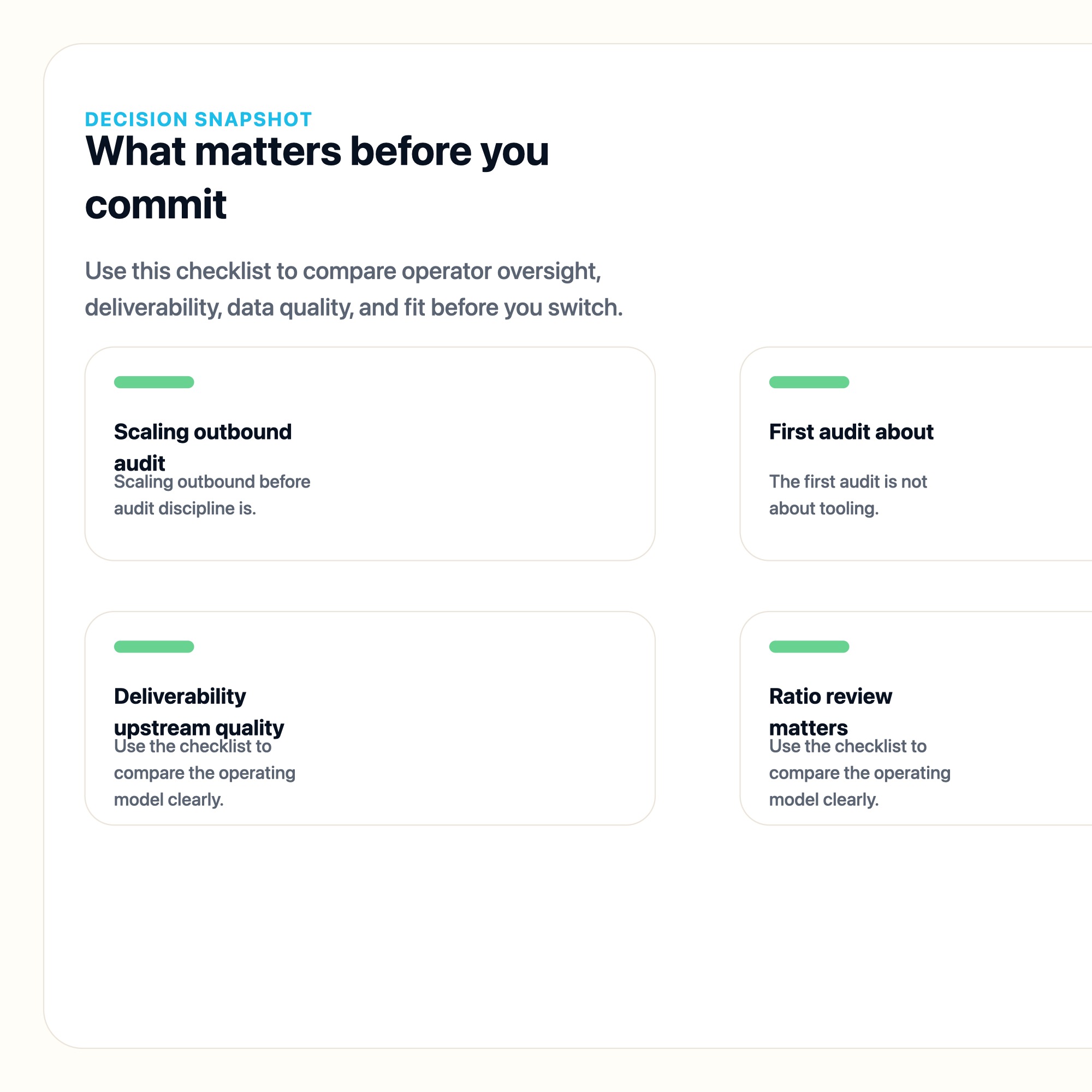
- Scaling outbound before audit discipline is usually a quality problem, not a volume problem.
- The first audit is not about tooling. It is about ICP, proof, deliverability, and whether the motion deserves more volume at all.
- Deliverability is an upstream quality control, not just a technical checklist.
- Ratio review matters because weak systems can look fine until one conversion layer collapses.
- Human QA matters because bad-fit segments, weak claims, noisy replies, and low-quality meetings usually need operator judgment to catch early.
Why outbound should be audited before it is scaled
A lot of teams treat scale like the fix.
Replies are soft, so they add volume. Meetings are weak, so they widen the list. Results are inconsistent, so they add more automation.
That usually makes the real problem worse.
Outbound should be audited before it is scaled because small quality issues compound fast once more send volume goes into the system. A weak ICP, weak proof, weak infrastructure, or weak follow-up logic can still look acceptable at low volume. Once the motion scales, the damage gets more obvious and more expensive.
That is why the first question is not, "How do we send more?" It is, "What exactly are we scaling?"
Audit the ICP and targeting first
Most outbound problems start here.
If the wrong buyers are being targeted, the rest of the system will look worse than it really is. Copy gets blamed. Tooling gets blamed. AI gets blamed. But the motion was pointed at the wrong people from the start.
That is why segmentation quality should be audited before message quality.
The practical questions are simple:
- are these actually the right accounts?
- are these the right titles inside those accounts?
- are these people close enough to the pain to care?
- is the ICP narrow enough to produce a consistent message and proof layer?
This is also where founder-led teams get into trouble with broad lists. A loose ICP makes every downstream metric harder to interpret.
A strong outbound audit catches that before the system scales.
Audit the offer and proof before blaming the channel
A lot of outbound messages fail because the meeting reason is weak, not because the channel is broken.
If the offer is broad, the proof is generic, or the message does not connect to the buyer's actual pain, more sends usually just produce more low-quality activity.
That is why proof needs to be audited as part of the motion.
The useful standard is not whether the claim is technically true. It is whether the proof is believable and relevant to the buyer. A generic big logo is often weaker than proof that clearly maps to the prospect's world.
This is one reason Convert's public operating model is useful. Public materials describe research dossiers built from signals like news, podcasts, reports, and broader enrichment inputs. That matters because it points to a system built around relevance and buyer context, not just generic personalization.
If the reason for the meeting is weak, the audit should catch that before scale makes the weakness harder to ignore.
Audit deliverability like infrastructure, not cleanup
Deliverability is not a side task. It is part of the audit.
If inbox health is weak, reply quality usually gets noisier. Trust drops. Signal quality gets worse. And once that happens, the rest of the motion becomes harder to judge accurately.
That is why deliverability should be reviewed before more volume is added.
Based on the public Convert playbook and homepage, the public operating model includes 100+ warmed inboxes, a supplementary-domain setup built around roughly 10 domains and 100 inboxes, a 14-day warm-up ramp from 5 to 50 sends per day, plus SPF, DKIM, DMARC, inbox placement tests, blacklist monitoring, and rotation discipline.
That matters because it shows a real audit posture around sender health, not just a launch checklist.
A simple process visual belongs here. It should show the audit path from domain and inbox setup, to launch review, to reply monitoring, to ratio review, to scaling decision.
Audit campaign quality through the ratios that matter
This is where weak systems start to show themselves.
A campaign can look fine on the surface and still be breaking underneath. That is why raw activity is not enough.
The most useful audit ratios are:
- sent-to-reply
- reply-to-positive
- positive-to-meeting
And after that, one more question matters: are the meetings actually useful to the pipeline?
These ratios help isolate where the motion is weakening.
If sent-to-reply is weak, the issue may be deliverability, targeting, or message relevance. If reply-to-positive falls, the issue may be proof quality, fit, or offer strength. If positive-to-meeting falls, the problem may be qualification, intent, or meeting usefulness.
Convert's public materials are useful here too because they explicitly reference QA tied to sent-to-reply, reply-to-positive, and positive-to-meeting ratios. That matters because it shows a real feedback loop before more scale gets added.
Human QA is part of the audit, not an extra layer
A lot of weak outbound systems look acceptable until a human actually reviews what is happening.
This is where operator judgment matters.
Human QA helps catch things like:
- bad-fit segments that should not be in the motion
- weak claims that sound fine internally but do not land with buyers
- noisy reply patterns that point to trust or targeting issues
- low-quality meetings that should not be counted as success
That is also why managed AI outbound should not be judged only by what gets automated. It should be judged by what gets reviewed before the system scales.
Based on Convert's public operating model, human review matters before deployment and during post-launch QA. That matters because it gives the audit a real owner.
Know when to stop scaling and fix the system first
Some teams are poor candidates for scale-first outbound.
That is not because they need less ambition. It is because the system underneath the motion is not ready.
A team should usually stop scaling and fix the system first if:
- the ICP is still vague
- the proof is weak or generic
- sender health is unstable
- the ratios are soft in the wrong places
- meetings are getting booked but not turning into useful pipeline
That fit boundary matters. Teams with no clear ICP, no real proof, or no patience for system cleanup are usually poor candidates for scale-first outbound.
What a real outbound audit should answer
If the audit is working, it should answer a few plain questions.
- are we targeting the right buyers at all?
- is the meeting reason specific and believable?
- is sender health strong enough to trust the signal?
- do the ratios suggest quality is holding up?
- is human review catching weak-fit activity before it compounds?
That is what a real audit looks like.
If you want a practical outside-in read on whether your outbound system is actually ready for more scale, book time with Convert.
Want the operator view?
If you want the exact setup we’d use for your outbound, book time with us. We’ll show you what to fix first, what to automate, and where human QA still matters.