
Operator comparison guide
Managed AI SDR does not beat spray-and-pray automation because it uses more AI.

That is the real distinction. Not AI versus no AI. Operator-run versus unmanaged.
TL;DR
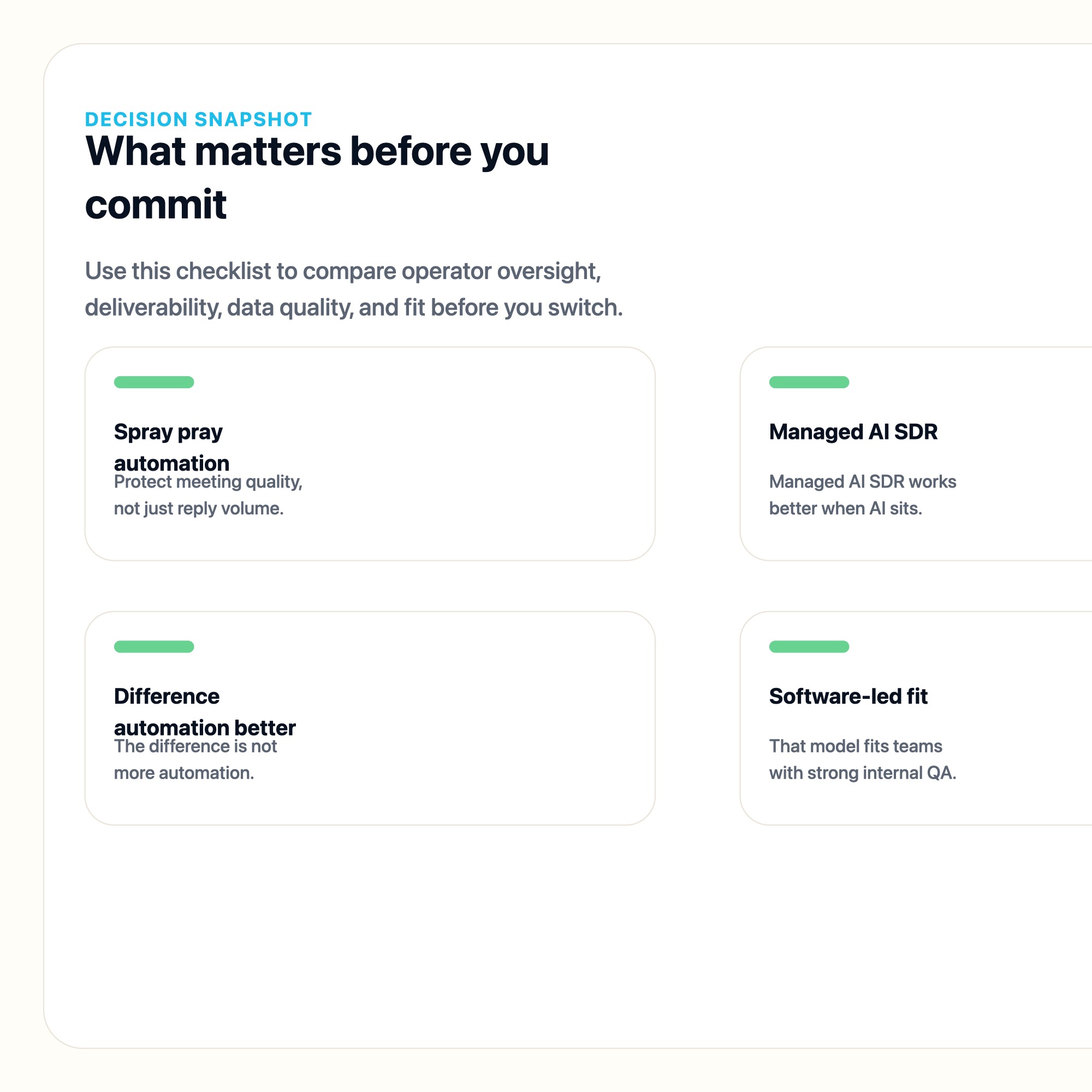
- Spray-and-pray automation usually shows up as broad targeting, weak-fit accounts, weak proof, loose QA, and activity metrics that hide bad meeting quality.
- Managed AI SDR works better when AI sits inside a system with stronger ICP discipline, better verification, deliverability controls, and human QA.
- The difference is not more automation. It is better controls.
- Software-led automation can still work when a team has strong internal QA and outbound ownership.
- If nobody owns targeting quality, claims, deliverability, and meeting quality, more automation usually just creates more noise.
Who this teardown is for
This page is for founders, sales leaders, and RevOps operators who are skeptical of generic AI SDR hype and want to understand why some outbound systems compound while others just create more noise.
If that is where you are, the goal is not to attack software. It is to get clear on what makes one outbound model operator-run and another one vanity-driven.
What spray-and-pray automation usually gets wrong
Spray-and-pray automation can look different on the surface, but the pattern is usually the same.
The targeting is too broad. Weak-fit accounts make it into the motion. The proof does not really match the buyer. QA is loose. Activity goes up, but meeting quality does not improve with it.
That is where teams get fooled.
The dashboard moves. Send volume rises. Replies happen. Calendar activity shows up. It all looks like progress.
But the system underneath is noisy.
That is why the real problem is not automation itself. The problem is unmanaged automation with weak controls, weak targeting, and weak measurement.
What managed AI SDR does differently
Managed AI SDR should mean more than software plus send volume.
It should mean tighter ICP discipline, better data verification, stronger domain and inbox strategy, deliverability monitoring, human review of recommendations and copy, and quality metrics that go beyond raw activity.
That is why Convert's public operating model is useful here. Not because it says "AI SDR." Because it shows the operator layer in specifics.
Public materials describe 100+ warmed inboxes, a playbook built around roughly 10 domains and 100 inboxes, and a 14-day warm-up ramp from 5 to 50 sends per day. They also call out SPF, DKIM, DMARC, placement tests, blacklist monitoring, and inbox rotation discipline.
That is infrastructure, not just automation.
A comparison visual belongs here. It should show spray-and-pray automation on one side and an operator-run managed system on the other, then compare targeting discipline, deliverability controls, QA ownership, and success metrics.
The concrete operational differences
Targeting and verification
Spray-and-pray automation usually gets sloppy here first.
Broad targeting creates weak-fit accounts. Weak-fit accounts create weaker messaging. Then the team blames copy or the channel when the real issue started in the data and targeting layer.
An operator-run system treats verification as part of outbound quality control.
At a high level, the kind of agentic verification workflow Convert references is useful here: Opportunity Detective, False-Positive Filter, Tenure Audit, Contact Cascade, and Angle Generator. That matters because it shows AI being used to improve targeting and routing inside a controlled system, not to excuse weak inputs.
Deliverability and infrastructure
This is where the gap gets expensive.
Spray-and-pray systems tend to treat deliverability like setup work. Managed systems treat it like infrastructure that has to stay healthy over time.
That difference matters. Sender health changes what signal you can trust from the motion.
Human QA and copy review
This is another big split.
A lot of software-led automation can generate drafts. That is not the same as having a real review layer before those drafts hit the market.
Convert's public materials say AI recommendations are human-reviewed before deployment. That matters because it puts a real control layer between generation and launch.
Quality measurement
Spray-and-pray systems usually over-weight activity.
Operator-run systems care more about whether the activity is turning into qualified conversations.
Convert's public QA layer references:
- sent-to-reply ratio
- reply-to-positive ratio
- positive-to-meeting ratio
Those metrics matter because they show where the system is actually weakening.
Healthy vs risky signals
Healthy signals
A healthy outbound system usually looks like this:
- ICP discipline is tight enough to support relevant messaging
- data verification happens before scale
- domains and inboxes are treated like maintained infrastructure
- human review exists before launch
- the team tracks conversation quality, not just activity volume
- transcript or feedback loops help the system improve over time
Convert's public materials reference transcript-powered feedback and content loops through Fathom and Fireflies. That matters because good systems should learn from live conversations, not just from dashboards.
Risky signals
A risky system usually looks like this:
- broad targeting is accepted as normal
- weak claims make it into market-facing copy
- deliverability is treated like a one-time setup task
- send volume gets celebrated while meeting quality stays vague
- nobody can clearly explain who owns QA
- the workflow looks advanced, but the controls are thin
That is how teams end up with more automation and worse signal.
Where software-led automation still has a place
This is not an argument against software.
Software-led automation can still be a good fit when a team has strong internal QA, clear outbound ownership, and someone who will actually catch weak targeting, weak claims, and noisy reply patterns.
Some teams want that control and are willing to own the extra burden that comes with it.
That can work.
The issue is not software. The issue is pretending software removes the need for operator judgment.
Where managed execution is the better fit
Managed execution is usually the better fit when a team wants the leverage of AI without taking on the full operational burden of deliverability, QA, verification, and meeting-quality accountability themselves.
That is where a deliverability-first AI outbound model with human QA and operator oversight becomes a meaningful distinction.
Not because it uses more AI. Because it puts better controls around the AI.
FAQ
What is spray-and-pray automation in outbound?
It usually means broad targeting, weak-fit accounts, poor proof alignment, loose QA, and success metrics that hide low-quality meetings behind activity volume.
Why does managed AI SDR work better?
It works better when AI operates inside a system with tighter targeting, stronger verification, deliverability controls, human review, and quality metrics beyond send volume.
Is this an argument against software-led outbound?
No. Software-led outbound can still work if the team has strong internal QA, outbound ownership, and enough discipline to manage the system well.
What should buyers look for in an operator-run outbound model?
They should look for deliverability infrastructure, data verification, human review of copy and recommendations, meeting-quality accountability, and clear ownership of what happens after launch.
If you want a practical outside-in read on whether your outbound system is operator-run or just noisier automation, book time with Convert.
Want the operator view?
If you want the exact setup we’d use for your outbound, book time with us. We’ll show you what to fix first, what to automate, and where human QA still matters.