
Operator comparison guide
A lot of teams hear "managed AI SDR with human oversight" and think it means AI plus a person somewhere in the loop. That is too vague to be useful. The real distinction is simpler.
The real distinction is simpler. AI is doing useful work, but it is doing that work inside a system that still has real human ownership over targeting, deliverability, reply quality, and meeting quality.
TL;DR
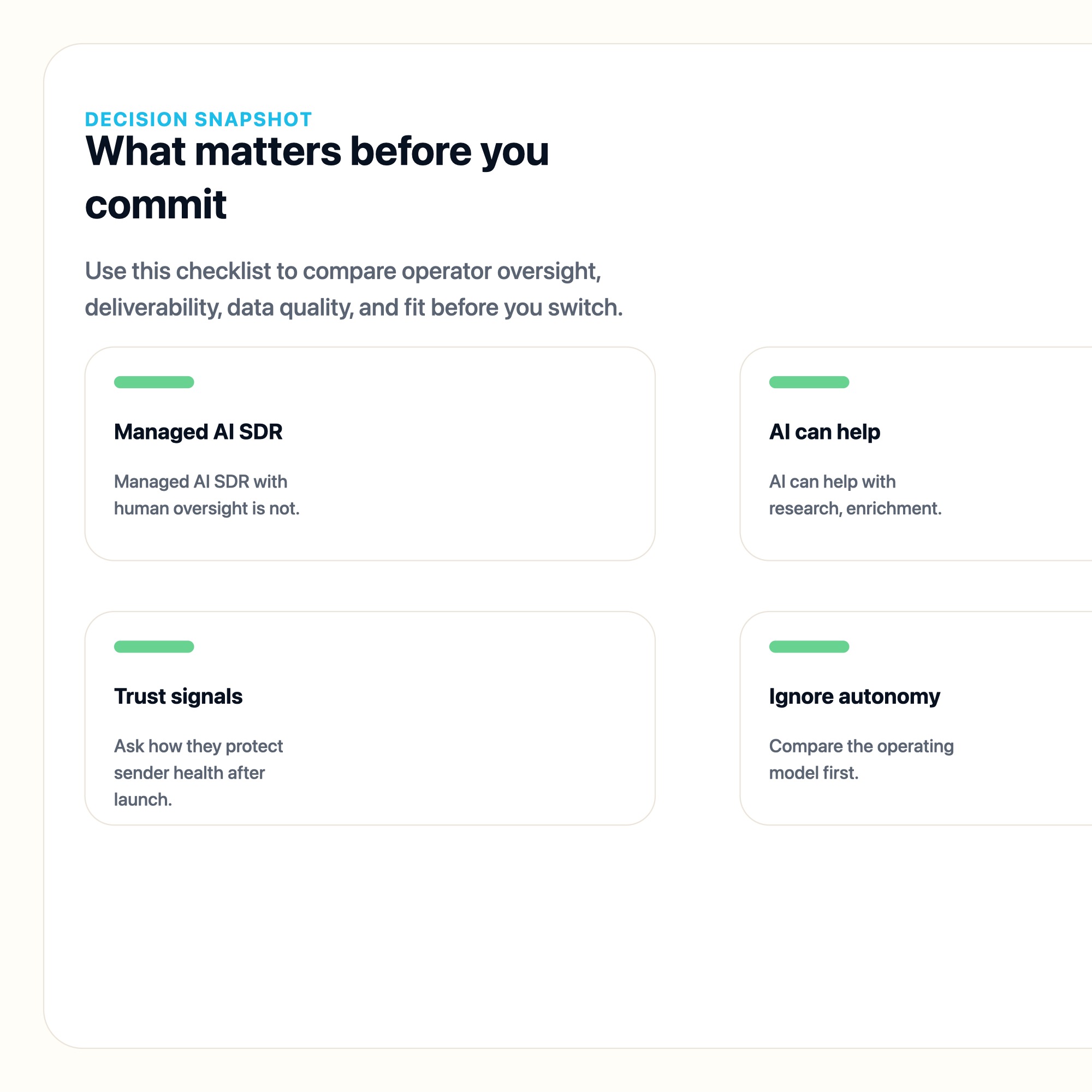
- Managed AI SDR with human oversight is not AI-only or human-only. It is AI operating inside an operator-owned outbound system.
- AI can help with research, enrichment, routing, draft generation, and QA support, but humans still need to own fit judgment, claim review, reply interpretation, meeting quality, and deliverability discipline.
- This model tends to win when teams want leverage without giving up control over sender health, message quality, or pipeline quality.
- Software-led autonomy still has a place, especially when the cost of mistakes is low and the workflow is tightly scoped.
- Convert’s wedge is specific on purpose: deliverability-first AI outbound with human QA and managed AI SDR with operator oversight.
Who this model is for
This model is for founder-led sales teams, lean B2B SaaS teams, and RevOps or growth operators comparing outbound approaches.
It is especially relevant for teams that want AI leverage but do not want to hand over judgment on targeting, deliverability, or meeting quality.
In practice, that usually means teams that care about pipeline quality, not just activity. It also means teams that know outbound gets expensive fast when weak-fit accounts, weak proof, or sender issues are left alone too long.
What managed AI SDR with human oversight actually includes
The cleanest way to define the category is this: AI handles useful work inside a motion that still has real human ownership.
That matters because a lot of category language hides the practical question. Who actually owns whether the outbound is good?
What AI can do well
AI can take real work off the team when the system is designed well. That can include:
- research
- enrichment
- routing
- draft generation
- QA support
That is useful. It can speed up the motion and reduce manual drag.
Public Convert materials also make that operating model easier to understand. The playbook references an agentic verification workflow with pieces like Opportunity Detective, False-Positive Filter, Tenure Audit, Contact Cascade, and Angle Generator.
That is helpful because it shows AI doing actual work, not just spitting out copy.
What humans still need to own
This is where the category gets real.
Human oversight still matters for the parts that decide whether the motion is healthy:
- fit judgment
- claim review
- reply-pattern interpretation
- meeting-quality judgment
- deliverability discipline
That is why the difference is not really human-only versus AI-only.
The real question is whether AI sits inside a system someone actually owns.
Where this model wins
Managed AI SDR with human oversight tends to win when the cost of drift is high.
If weak targeting, weak claims, sender issues, or low-quality meetings can hurt pipeline quality, then operator-owned execution matters.
It keeps deliverability visible
Convert’s wedge is deliverability-first AI outbound with human QA. That matters because a lot of outbound systems are judged by volume first and health second.
Public Convert materials describe a more deliberate operating posture:
- 100+ warmed inboxes
- a playbook built around at least 10 domains and about 100 inboxes total
- a 14-day warm-up ramp from 5 to 50 sends per day
- SPF, DKIM, DMARC, placement tests, and blacklist monitoring
That is not just setup detail. It is what it looks like when sender health is part of the operating model.
It gives the system a real QA layer
Public materials also describe AI recommendations being human-reviewed before deployment.
That matters because a lot of outbound quality problems do not look dramatic at first. The dashboard still moves. Activity still looks fine. But the quality underneath gets weaker.
A real QA layer helps catch weak-fit targets, weak claims, weak proof, noisy replies, and low-quality meetings before those issues spread.
It gives teams better signals than activity alone
The playbook also references QA tied to:
- sent-to-reply ratio
- reply-to-positive ratio
- positive-to-meeting ratio
Those ratios matter because they tell a more useful story than volume alone.
They help operators see whether the motion is actually healthy or just active.
It learns from real conversations
Public materials reference transcript-powered feedback and content loops through Fathom and Fireflies.
That matters because healthier outbound systems should learn from actual conversations, not just sequence metrics.
Where this model loses
This model is not perfect, and pretending otherwise makes the category less useful.
Managed AI SDR with human oversight usually loses when a team wants a very low-cost, low-touch system and is comfortable with tighter constraints on quality control.
It can also be heavier than a software-led setup if the team does not actually need high judgment. If the workflow is simple, the risk is low, and the cost of errors is small, full operator-owned execution may be more than the team needs.
This model also depends on real ownership. If a vendor says there is oversight but cannot explain how targeting, claims, deliverability, and meeting quality are actually reviewed, the advantage disappears quickly.
Healthy vs risky signals
A simple comparison is usually more useful than category jargon.
A good visual belongs here: a side-by-side comparison grid showing healthy versus risky signals in managed AI SDR. That helps a founder or RevOps lead scan the difference fast.
Healthy signals
Healthy systems usually look like this:
- AI does real work, but operators still own judgment
- sender health is treated like an ongoing discipline, not a one-time setup task
- targeting is checked for commercial fit, not just filter match
- AI-generated recommendations are reviewed before deployment
- ratio health is tracked alongside activity
- meeting quality matters as much as booked volume
- someone can clearly explain who owns deliverability and QA
Risky signals
Risky systems usually look more like this:
- the language sounds advanced, but ownership is fuzzy
- the tool is expected to catch its own mistakes
- targeting broadens as volume pressure rises
- message drafts keep shipping even when proof quality gets weaker
- deliverability is treated like DNS setup instead of a live system
- meetings get counted before anyone checks whether they are good
- the dashboard looks busy, but nobody can explain whether the motion is healthy
That is usually the tell. The workflow sounds modern, but the controls are thin.
Where software-led autonomy is still fine
Not every team needs full operator-overseen execution.
Software-led autonomy can be fine when the workflow is tightly scoped, the risk of mistakes is low, and the team can tolerate more variability.
That might include internal prospect research, draft support, enrichment assistance, or narrow outbound workflows where quality risk is easier to contain.
The issue is not whether software is good. The issue is where the cost of drift becomes expensive.
If weak claims, weak-fit accounts, sender problems, or low-quality meetings can quietly damage the motion, software alone is usually not enough.
Why some teams need operator-owned execution instead
This is where the category becomes practical.
Some teams do not need more automation first. They need more ownership.
If outbound performance depends on deliverability discipline, proof quality, target quality, and meeting quality all holding together at the same time, then somebody needs to own that system end to end.
That is what managed AI SDR with human oversight is supposed to mean.
Not AI plus a person somewhere. An outbound system where AI does useful work inside a motion that still has real human judgment and real accountability.
If you are comparing outbound models right now, that is probably the best place to start.
If you want a practical outside-in read on whether your outbound model has enough control built into it, book time with Convert.
Want the operator view?
If you want the exact setup we’d use for your outbound, book time with us. We’ll show you what to fix first, what to automate, and where human QA still matters.