
Operator comparison guide
Most founder-led teams do not need more outbound software. They need a simple operating model that protects deliverability, keeps targeting honest, and produces meetings worth taking. That is the point of this playbook.
That is the point of this playbook. The goal is not to automate more chaos. It is to build an outbound motion that can scale without damaging sender reputation or wasting founder time.
TL;DR
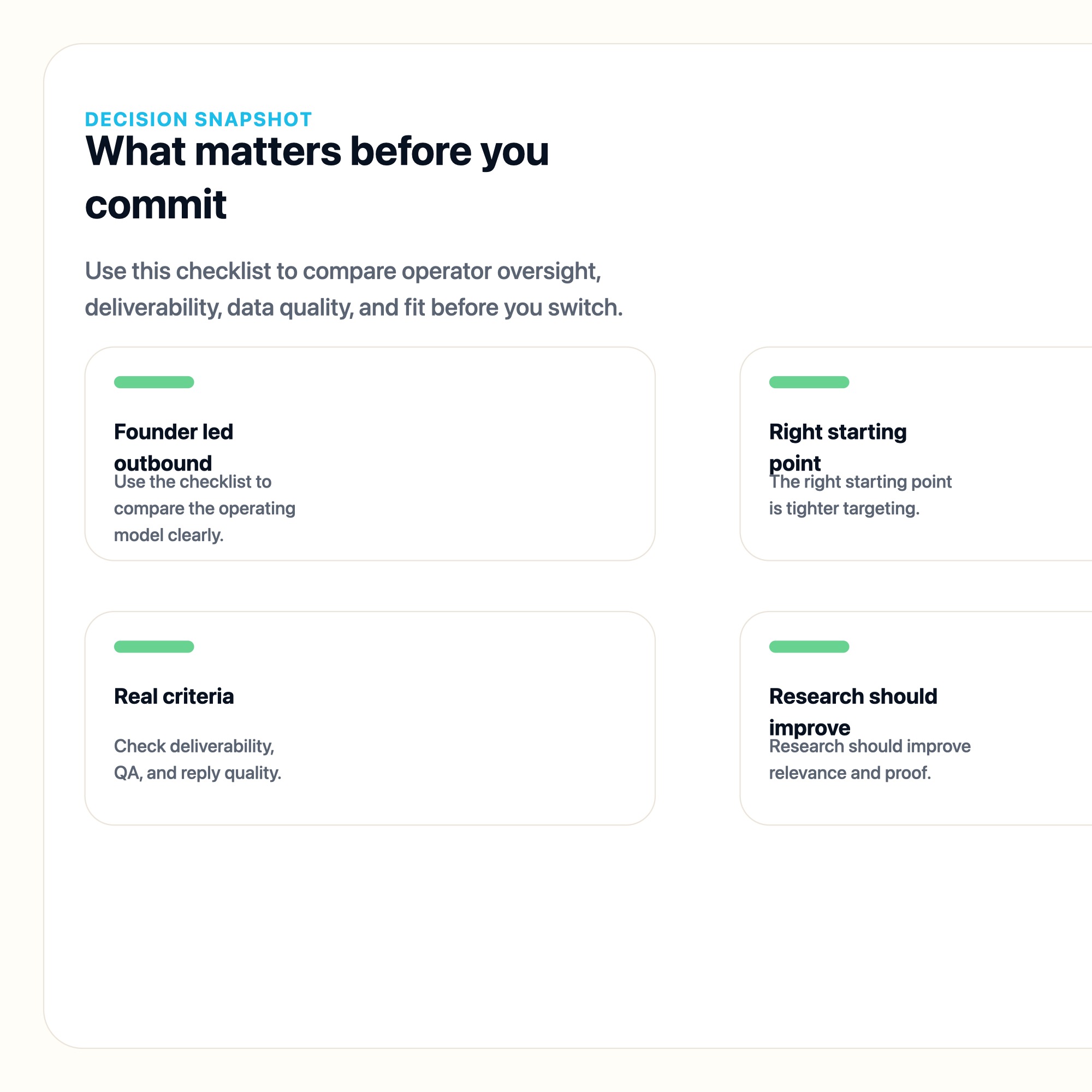
- Founder-led outbound usually breaks when teams chase scale before they have a reliable system.
- The right starting point is tighter targeting, better proof, stronger inbox infrastructure, and human review at the right checkpoints.
- Deliverability should be treated as infrastructure, not cleanup after performance slips.
- Research should improve relevance and proof, not create fake personalization.
- The right metrics are not just sends or meetings. They are the ratios that show whether quality is holding up.
Start with the wedge, not the tool stack
Most founder-led outbound gets weaker the moment the team starts with tools instead of positioning.
The first job is to define who the motion is actually for, what problem you solve, and what proof will feel credible to that buyer. If that part is vague, more software just helps you scale confusion.
This is also where many teams get personalization wrong. They think the answer is a clever opener. Usually it is better proof.
The proof has to match the buyer's world. A big logo is not always the best proof. The better proof is usually the one that feels closest to the prospect's context, risk, or category.
For founder-led teams, this usually means narrowing the ICP before building volume. It is easier to scale a tight wedge than to rescue a broad one.
Protect deliverability before you scale volume
This is where a lot of founder-led teams get hurt.
They treat deliverability like setup work. Then they start sending. Then they try to fix problems after performance drops.
That order is backwards.
Deliverability should be treated as infrastructure. The public Convert playbook is useful here because it frames the system in operational terms, not just technical terms. Public materials describe 100+ warmed inboxes, a supplementary-domain setup built around roughly 10 domains and 100 inboxes, a 14-day warm-up ramp from 5 to 50 sends per day, plus SPF, DKIM, DMARC, inbox placement tests, blacklist monitoring, and rotation discipline.
That matters because founder-led teams usually do not have much margin for sender-reputation damage. Once domains get burned, the cleanup cost is real.
A simple visual belongs here. It should show the sequence from domain and inbox setup, to warm-up, to launch, to live monitoring. That makes the operating model easy to follow.
Build a research layer that improves relevance
AI can help a lot here. It can speed up research, organize signals, and make the targeting layer more usable.
But the standard should stay high. The goal is not fake personalization. It is relevant proof and a credible reason to reach out.
This is where research dossiers matter. Convert's public materials describe research built from signals like news, podcasts, reports, and broader enrichment inputs. That is more useful than generic "AI personalization" language because it points to a real relevance layer.
The right question is simple: does the research help you understand why this account should care?
If not, the message will still be weak even if it sounds polished.
Add human QA where mistakes get expensive
A lot of outbound failure comes from weak judgment, not missing automation.
That usually shows up when:
- the targeting looks right on paper but misses the actual buying context
- the proof is technically true but not compelling
- the offer is too broad
- the follow-up logic pushes too hard
- the campaign keeps running after quality is already slipping
This is where human QA matters.
The point is not to slow everything down. The point is to put human review at the checkpoints where mistakes get expensive.
Based on Convert's public operating model, that means AI can help with research and drafting, but human review still matters before deployment and during post-launch QA. That is the difference between using AI to accelerate the system and using AI to replace judgment.
Measure the right ratios, not just activity
Most teams track sends, replies, and meeting count.
Those numbers matter, but they are not enough. Founder-led teams need the ratios that show where the system is actually breaking.
The most useful ones are:
- sent-to-reply
- reply-to-positive
- positive-to-meeting
- meeting quality, not just meeting count
These ratios help you diagnose the real problem.
If sent-to-reply is healthy but reply-to-positive falls, the issue may be proof, targeting, or offer quality rather than infrastructure. If positive-to-meeting falls, the problem may be qualification, conversion, or downstream fit.
Convert's public materials are useful here too because they explicitly talk about QA tied to sent-to-reply, reply-to-positive, and positive-to-meeting ratios. That matters because it shows a real feedback loop, not just campaign launch.
Know when this model is a bad fit
This playbook is not right for every team.
It is probably a bad fit if:
- you want a fully self-serve software model with minimal operator involvement
- you do not have a clear offer or credible proof yet
- you are trying to scale chaos instead of fixing the system underneath it
- you want volume first and quality control later
That is not a knock on those teams. It is just better to say the fit boundary clearly.
This model works best for founder-led B2B teams that care about sender protection, qualified meetings, and tighter control over what gets scaled.
The practical takeaway
If founder-led outbound is underperforming, do not start by asking what software to add next.
Start by asking whether the ICP is narrow enough, whether the proof actually fits the buyer, whether deliverability is protected before launch, whether human review exists where mistakes get expensive, and whether the team is watching the right ratios after campaigns go live.
That is the real playbook.
AI can help. But for founder-led sales teams, the winning system is usually not the one with the most automation. It is the one with the best quality control.
If you want a practical outside-in read on whether your outbound motion is ready to scale, book time with Convert.
Want the operator view?
If you want the exact setup we’d use for your outbound, book time with us. We’ll show you what to fix first, what to automate, and where human QA still matters.