
Operator comparison guide
Most teams do not hurt deliverability because they used agents. They hurt deliverability because they dropped agents into a weak outbound system and treated automation like a substitute for infrastructure, QA, and judgment.
That is the real split. Agents can help a lot. They just do not remove the need for a healthy outbound system.
TL;DR
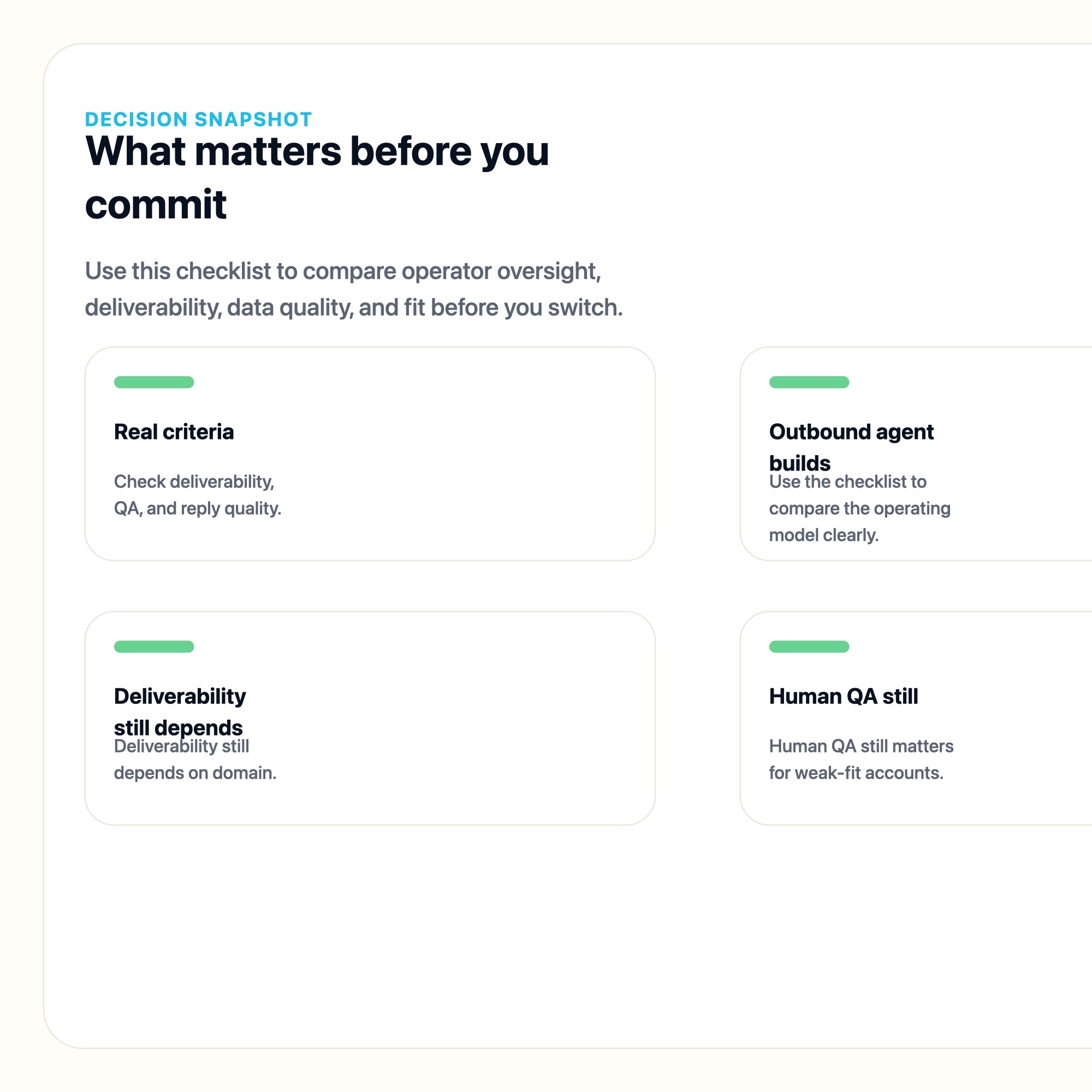
- Agents are useful for research, enrichment orchestration, verification, draft generation, routing, and QA support, but they do not replace deliverability infrastructure or human review.
- Most outbound-agent builds fail because teams treat agents like a scale hack instead of one part of an audited system.
- Deliverability still depends on domain strategy, inbox health,
SPF,DKIM,DMARC, warm-up discipline, placement tests, and blacklist monitoring. - Human QA still matters for weak-fit accounts, bad claims, poor personalization, noisy replies, and low-quality meetings.
- Before scaling agentic outbound, teams need to instrument the ratios that show whether quality is holding up.
Who this guide is for
This page is for founders, sales leaders, and RevOps operators who want to use outbound agents without wrecking deliverability, reply quality, or meeting quality.
If that is where you are, the goal is not to become anti-agent. The goal is to use agents where they help, while keeping human ownership where the cost of being wrong is too high.
Why most outbound-agent builds go wrong
Most outbound-agent builds do not fail because an agent was involved.
They fail because the system under the agent was weak.
The list was too loose. The proof was generic. The domain setup was shaky. Nobody owned QA. Then the team added more automation and called it progress.
That is how avoidable damage happens.
The workflow gets faster. The list gets bigger. The copy gets generated faster. Everything looks more advanced.
Meanwhile the wrong accounts are getting targeted, weak claims are slipping through, reply quality gets noisier, and low-quality meetings still get counted like wins.
That is why the first question is not, "How much can the agent automate?" It is, "What part of this system is safe to automate, and what still needs a human owner?"
Where agents genuinely help
Used well, agents can help a lot.
They are useful for:
- research
- enrichment orchestration
- verification
- draft generation
- routing
- QA support
At a high level, the kind of agentic verification workflow Convert references is a useful mental model here: Opportunity Detective, False-Positive Filter, Tenure Audit, Contact Cascade, and Angle Generator.
That matters because it frames agents as support for finding, checking, and routing better opportunities, not as a license to ignore the rest of the system.
A simple process visual belongs here. It should show the path from agent-assisted research and verification, to human review, to launch, to reply monitoring, to ratio review, to scaling decision.
Where humans still need to own deliverability and QA
This is the part teams skip.
Agents do not remove the boring work that actually protects outbound.
Deliverability still depends on:
- warmed inboxes
- domain rotation
SPF,DKIM, andDMARC- ramp discipline
- placement tests
- blacklist monitoring
That is why Convert's public operating model is useful. Public materials describe 100+ warmed inboxes, a playbook built around roughly 10 domains and 100 inboxes, and a 14-day ramp from 5 to 50 sends per day. They also call out SPF, DKIM, DMARC, placement tests, and blacklist monitoring.
That is a system, not just an automation layer.
Human QA also still matters for:
- weak-fit accounts
- bad claims
- poor personalization
- noisy reply patterns
- low-quality meetings
Convert's public materials add another useful point here: AI recommendations are human-reviewed before deployment. That is the real difference between responsible agent use and lazy automation.
Healthy vs risky implementation signals
Healthy signals
A healthy agentic outbound system usually looks like this:
- agents support research, verification, drafting, or routing inside a disciplined outbound process
- domain strategy and inbox health are owned like infrastructure
- human review exists before launch
- the team can explain what the agent owns and what a human still owns
- reply quality and meeting quality are reviewed, not assumed
Risky signals
A risky system usually looks like this:
- the team uses agents to increase volume before fixing targeting or proof
- deliverability gets treated like setup, not maintenance
- nobody reviews weak claims or weak-fit accounts before launch
- low-quality meetings still get counted like success
- the workflow is fast, but nobody can explain where quality control actually lives
That is the difference. Not whether agents exist. Whether the system around them is controlled.
What to instrument before scaling
If you want to scale agentic outbound safely, you need more than activity counts.
The core metrics still matter:
- sent-to-reply
- reply-to-positive
- positive-to-meeting
Those ratios help show where the system is weakening.
If sent-to-reply drops, the issue may be deliverability, targeting, or message relevance. If reply-to-positive softens, the problem may be proof quality, fit, or the offer. If positive-to-meeting falls, the issue may be qualification, intent, or meeting usefulness.
Convert's public QA framework references those ratios directly. Public materials also reference transcript-powered feedback loops through Fathom and Fireflies. That matters because a healthy system should learn from live conversations instead of repeating the same failure silently.
When managed execution may be better, and when an internal team can still do this well
Managed execution is usually a better fit when a team wants the benefits of agentic outbound but does not want to own the full QA, deliverability, and instrumentation burden internally.
That is where a deliverability-first AI outbound model with human QA and operator oversight matters.
But not every team needs a managed vendor.
An internal team can still do this well if it has strong outbound leadership, clear ownership of deliverability, disciplined QA, and the patience to instrument the system properly before chasing more scale.
The point is not that every team should use Convert. The point is that every team should be honest about what still needs human ownership.
FAQ
Do outbound agents hurt deliverability by default?
No. Agents do not hurt deliverability by default. Deliverability usually gets hurt when agents are added to a weak system that lacks domain discipline, inbox health controls, and human QA.
Where do agents help most in outbound?
They help most with research, enrichment orchestration, verification, draft generation, routing, and QA support.
What still needs human ownership?
Deliverability infrastructure, copy approval, weak-fit account review, bad-claim filtering, noisy reply review, and meeting-quality judgment still need human ownership.
What should teams monitor before scaling agentic outbound?
At minimum: sent-to-reply, reply-to-positive, positive-to-meeting, and whether transcript and feedback loops are actually improving the motion over time.
If you want a practical outside-in view on where agents help and where operator control still matters, book time with Convert.
Want the operator view?
If you want the exact setup we’d use for your outbound, book time with us. We’ll show you what to fix first, what to automate, and where human QA still matters.