
Operator comparison guide
This category gets muddy fast. A lot of AI SDR tools are sold on how autonomous they sound, not on how safe or useful they are once campaigns are actually live.
If you care about meeting quality and domain health, the better question is simpler: what kind of outbound system is least likely to create invisible damage while still producing qualified conversations?
TL;DR
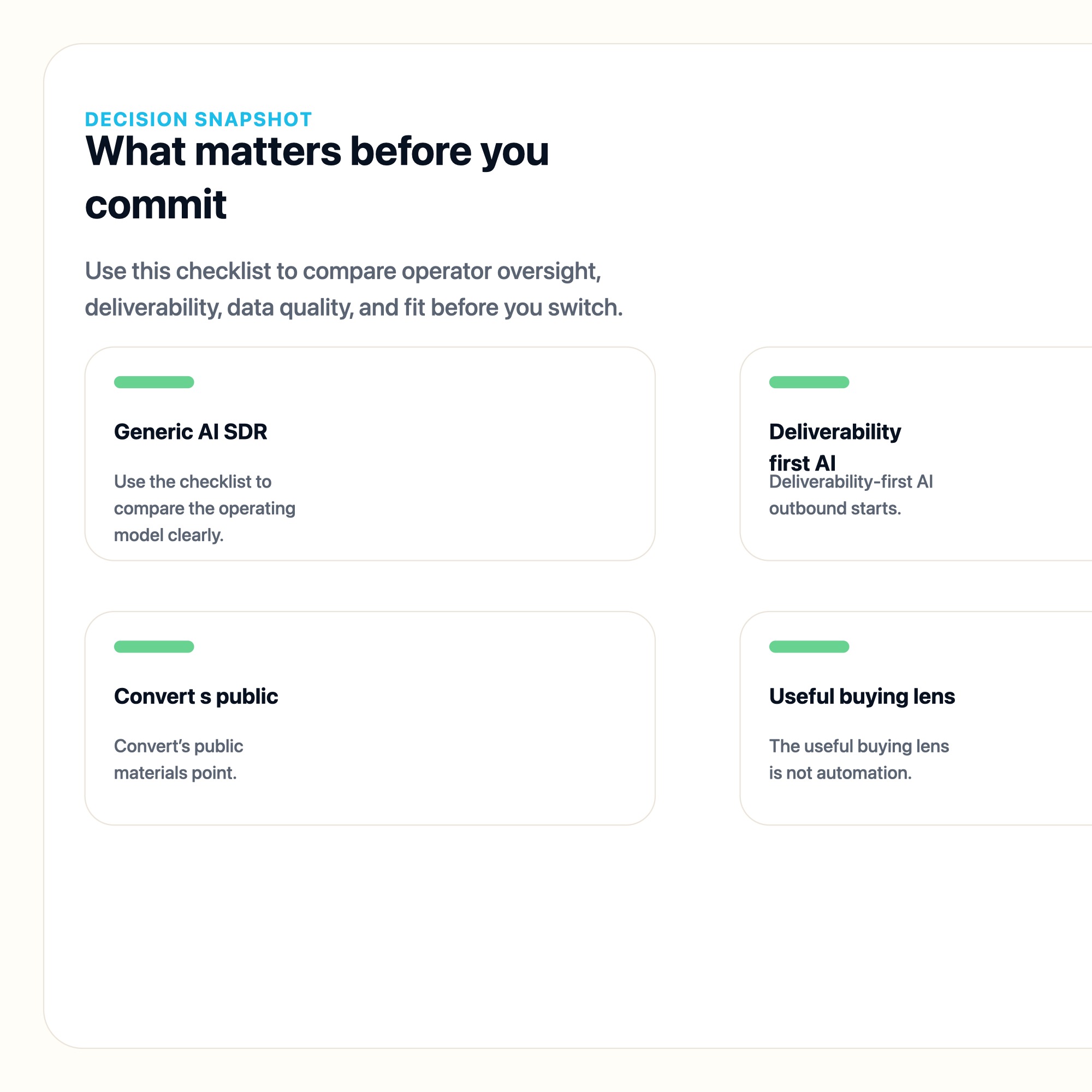
- Generic AI SDR automation can look good in a demo, but the real costs usually show up later in targeting quality, reply quality, and domain health.
- Deliverability-first AI outbound starts with tighter targeting, human-reviewed messaging, and real QA before it tries to scale activity.
- Convert’s public materials point to a more controlled model built around deliverability-first AI outbound with human QA.
- The useful buying lens is not automation volume. It is whether the system protects sender reputation while producing meetings worth taking.
- Better orchestration helps, but it does not replace human judgment, oversight, or evidence.
Why the generic AI SDR pitch falls short
Most AI SDR products are easy to understand at first glance.
They promise more automation, more activity, and faster execution. That makes sense in a pitch. It is clean, visible, and easy to demo.
But founder-led sales teams usually do not get hurt because they lacked activity. They get hurt by low-fit targeting, weak copy, inconsistent follow-up, and domain fatigue that builds quietly in the background.
That is why the category needs a better frame.
The useful question is not, "Which AI SDR has the most automation?" It is, "Which system is least likely to create invisible damage while still producing qualified meetings?"
What deliverability-first AI outbound changes
Deliverability-first AI outbound starts from a different operating principle.
You do not begin by asking how many sequences you can launch. You begin by asking how to protect sender reputation, maintain response quality, and book meetings that are actually worth taking.
That changes the whole motion.
Tighter targeting
Weak targeting does damage earlier than most teams realize.
One of the clearest operator lessons in Convert’s broader content corpus is that bad outbound data is expensive long before it is obvious. If the title is wrong, the contact is stale, or the account fit is weak, the message gets more generic and the team ends up cleaning data instead of creating pipeline.
That is why targeting is not just a list problem. It is one of the first quality controls.
Human-reviewed messaging
AI can speed up drafting. That does not mean it should ship on its own.
Another recurring Convert lesson is that most teams use the wrong proof in outbound. The issue is not just whether the first line sounds polished. It is whether the message uses proof that actually feels relevant to the buyer.
That is where human QA matters. It helps catch fake personalization, weak context, and shallow angles before they get scaled.
Deliverability and reply-quality QA
Deliverability is often treated like a setup checklist.
SPF, DKIM, DMARC, warm-up, and inbox rotation all matter. But they are not the whole system. A setup can look technically sound and still produce commercially dead outbound if the campaigns are weak and nobody catches the drift.
That is why deliverability-first AI outbound includes QA on both infrastructure and response quality.
Structured follow-up
Follow-up should create clarity, not noise.
When a system keeps sending after quality drops, it is not really automating well. It is just extending the damage. A stronger model uses structured follow-up and ongoing review instead of blind persistence.
What Convert says publicly that supports this wedge
Based on the Convert homepage and the Convert playbook, Convert is not positioning itself as generic AI SDR automation. The public case is more specific: deliverability-first AI outbound with human QA.
That matters because it points to a more controlled operating model.
Research before outreach
Convert says it uses AI research agents to build dossiers from signals like company news, podcasts, reports, hiring patterns, and tech stack clues.
That matters because many outbound misses happen before the message is written. The team never had a strong enough reason to reach out in the first place.
Verification before launch
The playbook names a verification flow that includes Opportunity Detective, False-Positive Filter, Tenure Audit, Contact Cascade, and Angle Generator.
That is more useful than generic AI prospecting language because it shows how the system is supposed to reduce stale records, weak-fit contacts, and shallow angles before campaigns go live.
Deliverability infrastructure
The playbook also recommends at least 10 supplementary domains and about 100 inboxes, with a one-month-on and one-month-off rotation plus a 14-day warm-up ramp.
It explicitly references SPF, DKIM, DMARC, placement testing, and blacklist monitoring.
That is not just technical decoration. It suggests the system is built to protect sender health as it scales.
Human QA and post-launch review
The homepage says AI drafts at scale but expert copywriters calibrate tone. The playbook goes further and says there is human oversight on AI suggestions before deployment.
It also describes post-launch monitoring on metrics like:
- sent-to-reply ratio
- reply-to-positive ratio
- positive-to-meeting ratio
That matters because campaign drift is real. A campaign can look fine at launch and still become commercially weak if targeting slips, copy degrades, or reply quality starts falling.
A simple visual belongs here
This is a good place for a simple process flow or comparison grid.
For example, a visual could show the difference between generic AI SDR automation and a deliverability-first model across five checkpoints: targeting, proof quality, message review, sender protection, and post-launch QA. That would make the distinction easier to scan for both buyers and internal sales use.
Why this framing matters beyond one article
This is not just a positioning exercise. It is also a clarity exercise.
If your outbound motion, playbook, and blog all reinforce the same wedge, buyers understand the difference faster. Answer engines do too.
The core message becomes easier to extract:
- deliverability-first AI outbound
- human QA
- operator oversight
- meeting quality over empty activity
That is a stronger and more credible story than generic AI SDR hype.
It also fits the current tooling reality. Agentic workflows are improving quickly, as shown by the latest GPT-5.4 release and the orchestration ecosystem documented in the OpenClaw docs.
But better orchestration does not remove the need for oversight. If anything, it makes operating discipline more important.
The practical takeaway
If you are comparing outbound systems, do not stop at the autonomy pitch.
Look at how the system validates targeting. Look at who reviews messaging. Look at what protects sender reputation. Look at how reply quality is measured. Look at what happens when campaigns drift.
That is the real test.
Convert’s public case is strongest through that lens: deliverability-first AI outbound with human QA, built to create qualified conversations without quietly degrading the channel.
FAQ
What is deliverability-first AI outbound?
It is an outbound model built to protect sender reputation, maintain reply quality, and keep human oversight in the loop where mistakes are expensive.
Why is generic AI SDR automation risky?
Because it can optimize for visible activity while hiding the real costs: weak targeting, weaker meetings, domain fatigue, and more cleanup later.
What makes Convert different?
Based on its public materials, Convert emphasizes research, verification, deliverability controls, human QA, and post-launch review instead of pure autopilot outreach.
Is better AI orchestration enough on its own?
No. Better orchestration helps, but it does not replace judgment, QA, or evidence.
If you want a practical read on whether your outbound system is protecting sender health and producing meetings worth taking, book time with Convert.
Want the operator view?
If you want the exact setup we’d use for your outbound, book time with us. We’ll show you what to fix first, what to automate, and where human QA still matters.