
Operator comparison guide
Most teams evaluate managed AI SDR vendors at the wrong layer.
That is the real decision. Not who has the slickest pitch. Who has an outbound system you can actually trust.
TL;DR
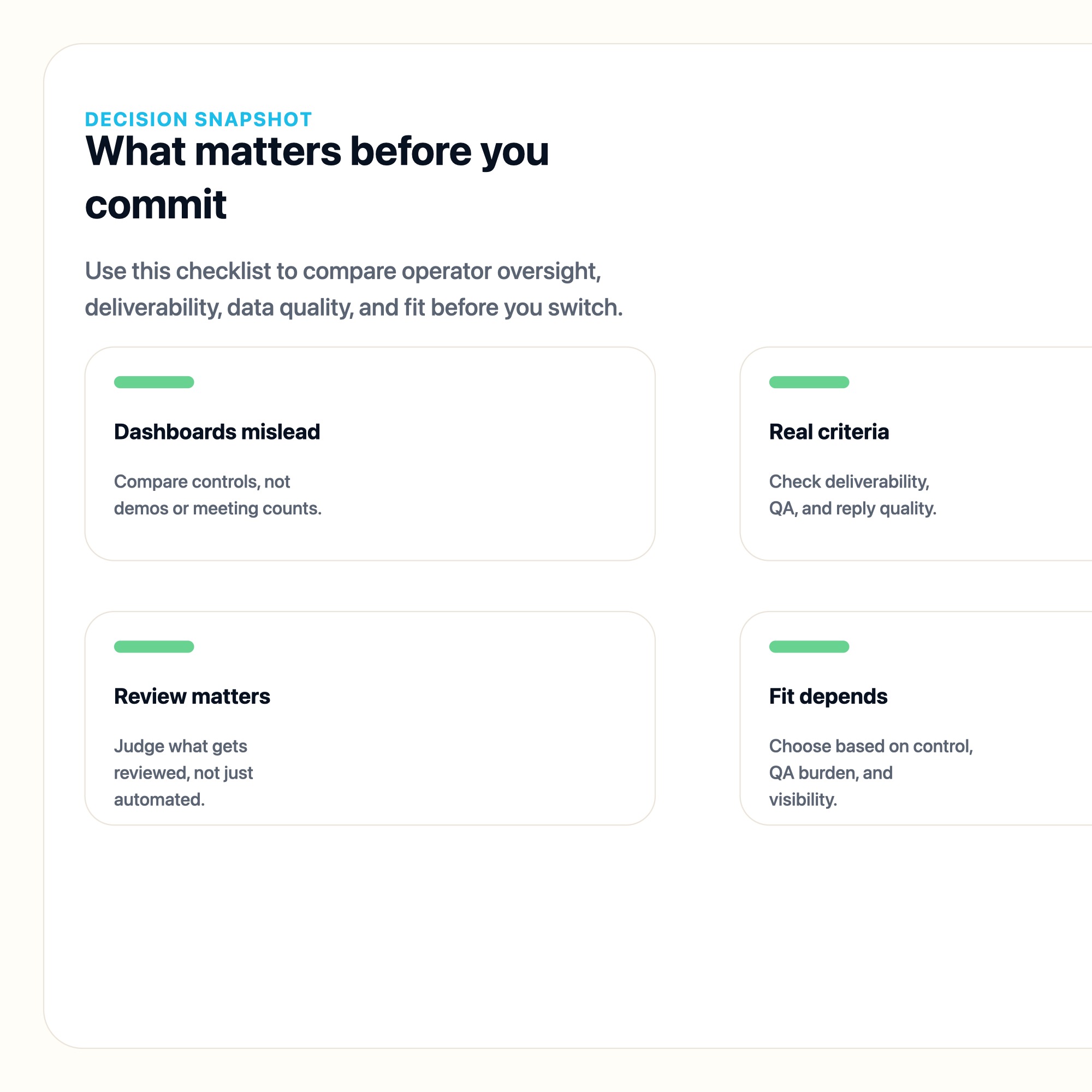
- Most vendor evaluations go wrong because buyers over-weight dashboards, automation language, and meeting counts.
- The real criteria are deliverability infrastructure, QA, data quality, targeting discipline, reply handling, and meeting-quality accountability.
- Managed AI outbound should be judged by what gets reviewed, not just what gets automated.
- Software-led tools, internal teams, and operator-heavy managed execution can all fit. The right choice depends on control, QA burden, and how much visibility the team needs.
- If a vendor cannot explain how they protect sender health, review output, and stay accountable for conversation quality, the risk is higher than the demo makes it look.
Who this evaluation guide is for
This page is for founders, sales leaders, and RevOps operators comparing managed AI SDR vendors, software-led outbound tools, or an internal outbound stack.
If you are trying to decide between those paths, the goal is not to become more suspicious. It is to ask better questions before you sign anything.
That matters because a lot of outbound systems can look impressive in a pitch and still be weak where it counts.
Why most managed AI SDR vendor evaluations go wrong
Most vendor evaluations start with the easiest things to compare.
A dashboard. A workflow demo. A booked-meeting number. A polished automation story.
That is usually the wrong layer.
The real issue is whether the vendor can run outbound in a way that protects deliverability, handles weak-fit signals, and gives the buyer enough visibility to understand what is actually happening. If those parts are weak, a clean demo does not save you.
That is why the first question should not be, "How much gets automated?" It should be, "How is this system run, reviewed, and kept healthy over time?"
The criteria that actually matter
1. Deliverability infrastructure and domain strategy
Start here.
A lot of managed AI SDR vendors talk about deliverability. Fewer make the operating model concrete.
The public Convert playbook is useful here because it gives buyers something specific to judge. Public materials describe 100+ warmed inboxes, a setup built around roughly 10 domains and 100 inboxes, a 14-day warm-up ramp from 5 to 50 sends per day, plus SPF, DKIM, DMARC, placement tests, blacklist monitoring, and rotation discipline.
That is the kind of detail a buyer should be looking for.
A comparison visual belongs here. It should show three columns: software-led vendor, managed execution partner, and internal stack, then compare deliverability ownership, QA burden, and visibility.
Healthy signal: the vendor can explain domain strategy, inbox posture, warm-up discipline, and monitoring without hiding behind vague language.
Risky signal: deliverability gets described like a checklist the team ran once and moved on from.
2. Warmed inbox posture and launch discipline
This is related to deliverability, but it deserves its own check.
You want to know how many inboxes are actually supporting the motion, how they are ramped, and what the launch discipline looks like.
If a vendor cannot explain the send ramp, inbox rotation, or how volume gets added safely, you are being asked to trust a system you cannot really inspect.
Healthy signal: the vendor can walk through inbox count, ramp logic, and what has to be true before volume increases.
Risky signal: the team talks about scale before it talks about sender health.
3. Copy quality and human QA
This is where generic AI SDR positioning usually starts to break down.
A lot of vendors can show automation. The better question is who reviews the output before it reaches the market.
Convert's public operating model matters here because it says AI recommendations are human-reviewed before deployment. That is an important distinction. It means the system is not judged only by what the model can generate. It is judged by what a real operator is willing to approve.
Ask:
- who reviews messaging before deployment?
- who catches weak claims or weak-fit segments?
- how often is copy adjusted after replies come in?
Healthy signal: there is clear human review before launch and after real feedback shows up.
Risky signal: the vendor treats automation itself like the quality guarantee.
4. Data enrichment, verification, and targeting discipline
Bad data gets expensive fast.
If the contacts are wrong, the titles are weak, or the ICP is loose, the vendor can still produce activity while the actual outbound quality gets worse.
That is why buyers need to understand how the vendor handles enrichment, verification, and targeting discipline.
Ask:
- how is accurate contact information validated?
- what makes an account good-fit or bad-fit?
- how much QA sits between raw data and launch?
Healthy signal: the vendor can explain how targeting and verification work before scale begins.
Risky signal: the team shows a lot of workflow automation but gets vague when asked how list quality is controlled.
5. Reply handling and positive-signal quality
Most buyers ask about meetings. Fewer ask what happens between the first reply and the booked conversation.
That gap matters.
A managed AI SDR vendor should be able to explain how positive signals are handled, how noise is filtered, and how low-quality replies are prevented from getting counted as success.
This is also where the ratio layer matters. Convert's public QA framework references:
- sent-to-reply ratio
- reply-to-positive ratio
- positive-to-meeting ratio
Those metrics matter because they show where the motion is getting weaker.
Healthy signal: the vendor tracks conversion quality between reply, positive signal, and actual meeting.
Risky signal: the vendor leans on top-line activity counts and gives little visibility into the layers underneath.
6. Operator visibility, reporting depth, and feedback loops
A buyer should not have to guess how the system is doing.
The question is not just whether the vendor sends reports. It is whether the reporting helps the buyer see what is working, what is drifting, and what needs intervention.
Convert's public materials also reference transcript-powered feedback loops through Fathom and Fireflies. That matters because it points to a system that can learn from live conversations, not just from dashboard activity.
Ask:
- what can i actually see as the buyer?
- what does reporting include beyond meeting counts?
- how are call transcripts or live feedback used to improve the motion?
Healthy signal: the buyer can see both activity and quality, including where the motion is weakening.
Risky signal: the reporting is clean but shallow, and the buyer cannot inspect what is really happening.
What to ask on calls and in proposals
If you want to pressure-test a vendor quickly, ask these directly:
- what does your deliverability infrastructure actually look like?
- how many warmed inboxes support the motion, and what does the send ramp look like?
- who reviews copy and AI recommendations before deployment?
- how do you handle positive replies, weak-fit replies, and noise?
- what metrics do you use beyond booked meetings?
- what can i actually see as the buyer during the engagement?
- where does your model work well, and where does it not?
That last question matters more than most buyers think. A vendor who cannot explain their own limitations is usually telling you less than you need to know.
Where managed execution fits, and where it may not
Managed execution is usually the better fit when a team wants outbound run with more operator oversight, stronger deliverability discipline, and less internal assembly burden.
That is different from software-led systems, which may offer more control but usually leave more QA, reporting interpretation, and process discipline on the buyer.
An internal team may still be the right answer if the company already has strong outbound leadership, good instrumentation, disciplined QA, and the time to own the system properly.
Clay-style stacks can also make sense for teams that want more control over enrichment and workflows and are willing to take on the extra QA burden that comes with that control.
The point is not that every buyer should choose Convert. The point is that every buyer should know what burden they are actually signing up for.
FAQ
What matters most when evaluating a managed AI SDR vendor?
The most important things are deliverability infrastructure, targeting discipline, copy quality, human QA, reply handling, meeting-quality accountability, and the visibility the buyer gets into the system.
How should buyers compare managed execution, software-led tools, and an internal stack?
Compare them on control, QA burden, deliverability ownership, reporting depth, and how much operator discipline the buyer will need to supply themselves.
Why are booked-meeting counts not enough?
Because top-line activity can hide weak targeting, weak reply quality, or low-value meetings. The buyer needs to understand what happens between send volume, replies, positive signals, and actual qualified conversations.
When is a software-led or internal model still a better fit?
When the team wants more control, has the internal discipline to manage QA and deliverability well, and is willing to own more of the operational burden directly.
If you want a practical outside-in view of how to judge these systems without buying on hope, book time with Convert.
Want the operator view?
If you want the exact setup we’d use for your outbound, book time with us. We’ll show you what to fix first, what to automate, and where human QA still matters.