
Operator comparison guide
Most lean B2B teams do not need more automation first. They need a better audit. That is usually the real break point. Outbound rarely falls apart because a team lacked one more tool.
That is usually the real break point. Outbound rarely falls apart because a team lacked one more tool. It usually falls apart because nobody checked whether targeting, infrastructure, proof, QA, and meeting quality were strong enough before more volume got pushed into the system.
TL;DR
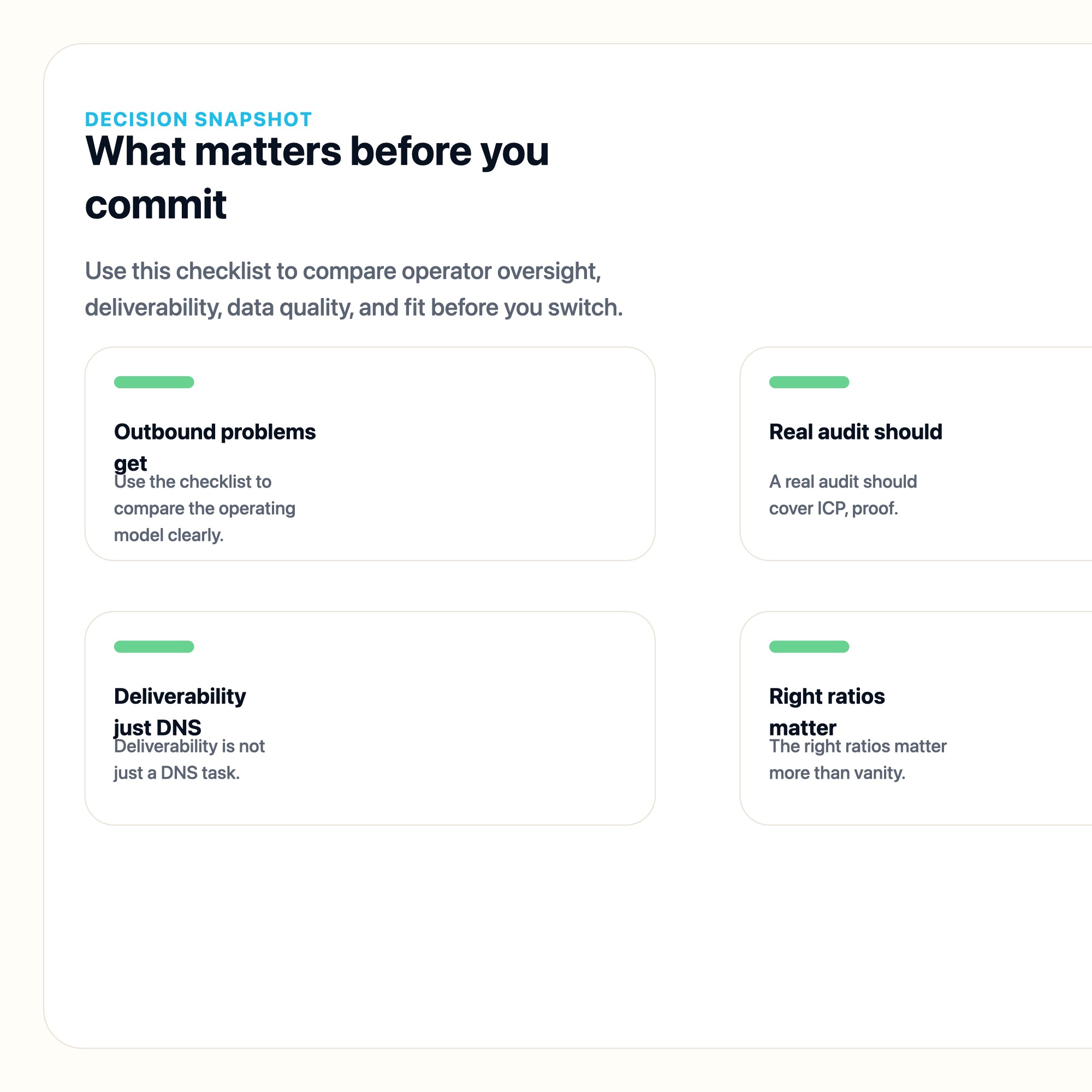
- Most outbound problems get worse when teams add scale before they audit the motion underneath it.
- A real audit should cover ICP, proof, deliverability, data quality, human QA, and whether meetings are actually useful.
- Deliverability is not just a DNS task. It is part of outbound quality control.
- The right ratios matter more than vanity activity because they show where the system is weakening.
- Some lean teams should fix process and instrumentation before they add more inboxes, automation, or SDR tooling.
Why lean teams need an outbound audit before more scale
A lot of lean teams respond to weak outbound the same way.
Replies are soft, so they add more volume. Meetings are mixed, so they widen the list. Results are inconsistent, so they add more automation.
That usually makes the real problem harder to see.
A weak outbound system can still produce enough activity to look acceptable for a while. But if the ICP is loose, the proof is generic, the infrastructure is unstable, or nobody owns QA, scale usually amplifies the weakness.
That is why the first question is not, "How do we send more?" It is, "What exactly are we scaling?"
Who this checklist is for
This page is for teams that already have some outbound motion in place and need to decide whether it deserves more scale.
That usually means:
- founder-led sales teams
- lean B2B SaaS teams
- RevOps or growth operators inheriting a shaky outbound system
If that is your situation, the goal is not more activity for its own sake. The goal is to find the fragile parts of the system before they get more expensive.
The operator checklist: what to audit before you add more volume
1. Targeting and ICP clarity
Start here.
If the ICP is loose, everything downstream gets harder to interpret. Weak segmentation makes proof weaker, personalization noisier, and meetings less useful.
Ask:
- is the ICP narrow enough to support a consistent message?
- are these actually the right accounts?
- are the right titles inside those accounts being targeted?
- are those people close enough to the pain to care?
Healthy signal: the team can clearly explain why these accounts and titles belong in the motion.
Risky signal: the list is broad, the titles are loosely related, and the team keeps blaming copy for what is really a targeting problem.
2. Domain and inbox infrastructure
This is where a lot of lean teams cut corners and pay for it later.
Deliverability should be treated as infrastructure, not cleanup. If sender health is weak, reply quality gets noisier and the rest of the system gets harder to judge accurately.
The public Convert playbook is useful because it makes the operating posture concrete. Public materials describe 100+ warmed inboxes, a setup built around roughly 10 domains and 100 inboxes, a 14-day warm-up ramp from 5 to 50 sends per day, plus SPF, DKIM, DMARC, placement tests, blacklist monitoring, and rotation discipline.
That is a real deliverability-first operating model, not just generic AI SDR packaging.
A checklist visual belongs well here. It should show the path from domain setup and warm-up to launch review, inbox monitoring, ratio review, and scaling decision.
Healthy signal: inboxes and domains are treated like a maintained system.
Risky signal: deliverability is treated like a one-time setup task.
3. Enrichment, verification, and accurate contact information
Bad outbound data is expensive long before it is obvious.
If the contact is wrong, the title is stale, or the account is weak-fit, the message gets generic fast. Then the team blames copy or channel performance when the issue started in the data layer.
Ask:
- is enrichment returning decision-useful fields?
- is the contact information accurate enough to trust?
- are titles and account attributes being verified before contacts enter the motion?
Healthy signal: the team validates data quality before pushing more volume.
Risky signal: the system keeps sending while everyone treats underperformance like a mystery.
4. Message-to-proof alignment
Most teams use the wrong proof in outbound.
They think personalization is the first line. Usually it is the proof behind the ask.
The better question is whether the meeting reason is specific and believable. A generic big logo is often weaker than proof that maps directly to the buyer's world.
Ask:
- does the proof fit the prospect's actual context?
- is the offer specific enough to justify a reply?
- does the message still make sense without vague AI claims?
Convert's public materials are useful here too because they describe research dossiers built from signals like news, podcasts, reports, and broader enrichment inputs. That suggests a relevance layer built around buyer context, not just surface-level personalization.
Healthy signal: proof feels close to the buyer's problem.
Risky signal: the message leans on generic logos, generic claims, or research theater.
5. Personalization quality and operator oversight
Not all personalization helps.
Sometimes it is just extra words sitting on top of a weak offer.
The practical standard is simple: does the personalization improve relevance, or is it trying to disguise weak segmentation?
This is also where operator oversight matters. Managed AI outbound should not be judged only by what gets automated. It should be judged by what gets reviewed.
Healthy signal: personalization sharpens relevance and someone is steering the system.
Risky signal: the workflow produces activity, but nobody is checking whether the output is actually good.
6. Reply handling, human QA, and the ratios that matter
This is where weak systems usually reveal themselves.
A lot of outbound motions look fine until somebody reviews the replies, the meeting quality, and the conversion layers between them.
Convert's public operating model matters here because it says AI recommendations are human-reviewed before deployment, and QA tracks:
- sent-to-reply ratio
- reply-to-positive ratio
- positive-to-meeting ratio
Those ratios are useful because they isolate where the system is weakening.
If sent-to-reply is weak, the issue may be deliverability, targeting, or message relevance. If reply-to-positive falls, the problem may be proof quality, fit, or offer strength. If positive-to-meeting falls, the issue may be qualification, intent, or meeting usefulness.
Healthy signal: the team watches the ratios and uses human QA to catch weak-fit accounts, weak claims, noisy replies, and low-quality meetings.
Risky signal: the team celebrates activity counts while the conversion layers quietly get worse.
When to fix the system before you scale it
The right answer is not always "add more volume."
Sometimes the audit should end with a stop sign.
A lean team should usually fix the system first if:
- the ICP is still vague
- the proof is weak or generic
- sender health is unstable
- the data layer is noisy
- nobody clearly owns QA
- the ratios are soft in the wrong places
- meetings are getting booked but not turning into useful pipeline
That is not a lack of ambition. It is operator discipline.
When Convert may be the better fit, and when DIY may still be fine
Convert is a better fit when a team wants deliverability-first AI outbound with human QA and operator oversight, not just more automation.
That matters when the team needs a managed system built around infrastructure discipline, human-reviewed AI recommendations, and quality meetings over vanity activity.
But not every team needs Convert.
If you already have a disciplined internal stack, strong proof, stable instrumentation, good deliverability hygiene, and someone who clearly owns quality control, DIY can still be fine. The point is not that every team should outsource outbound. The point is that every team should stop pretending scale fixes an unaudited system.
FAQ
What should an outbound audit include before scaling?
At minimum: ICP clarity, domain and inbox infrastructure, SPF / DKIM / DMARC, warm-up discipline, enrichment quality, accurate contact information, message-to-proof alignment, personalization quality, reply handling, human QA, ratio monitoring, and meeting quality.
Which metrics matter most in a lean outbound audit?
The most useful ones are sent-to-reply, reply-to-positive, positive-to-meeting, and whether meetings are actually useful to the pipeline.
Why is deliverability part of the audit?
Because weak sender health distorts reply quality and trust. That makes the rest of the system harder to evaluate honestly.
When should a team stop scaling and fix the system first?
When the ICP is vague, proof is weak, sender health is unstable, data quality is noisy, nobody owns QA, or meetings are not turning into useful pipeline.
If your outbound feels shaky, the answer is probably not more scale. It is a harder audit. If you want a practical outside-in read on where the system is fragile, book time with Convert.
Want the operator view?
If you want the exact setup we’d use for your outbound, book time with us. We’ll show you what to fix first, what to automate, and where human QA still matters.