
Operator comparison guide
Most AI SDR deliverability problems are not AI problems first. They are operating problems that got scaled before the system was ready. That is the distinction that matters.
That is the distinction that matters. If infrastructure is thin, targeting is loose, and nobody is catching weak output before launch, AI does not save the motion. It just helps the team make the same mistake faster.
TL;DR
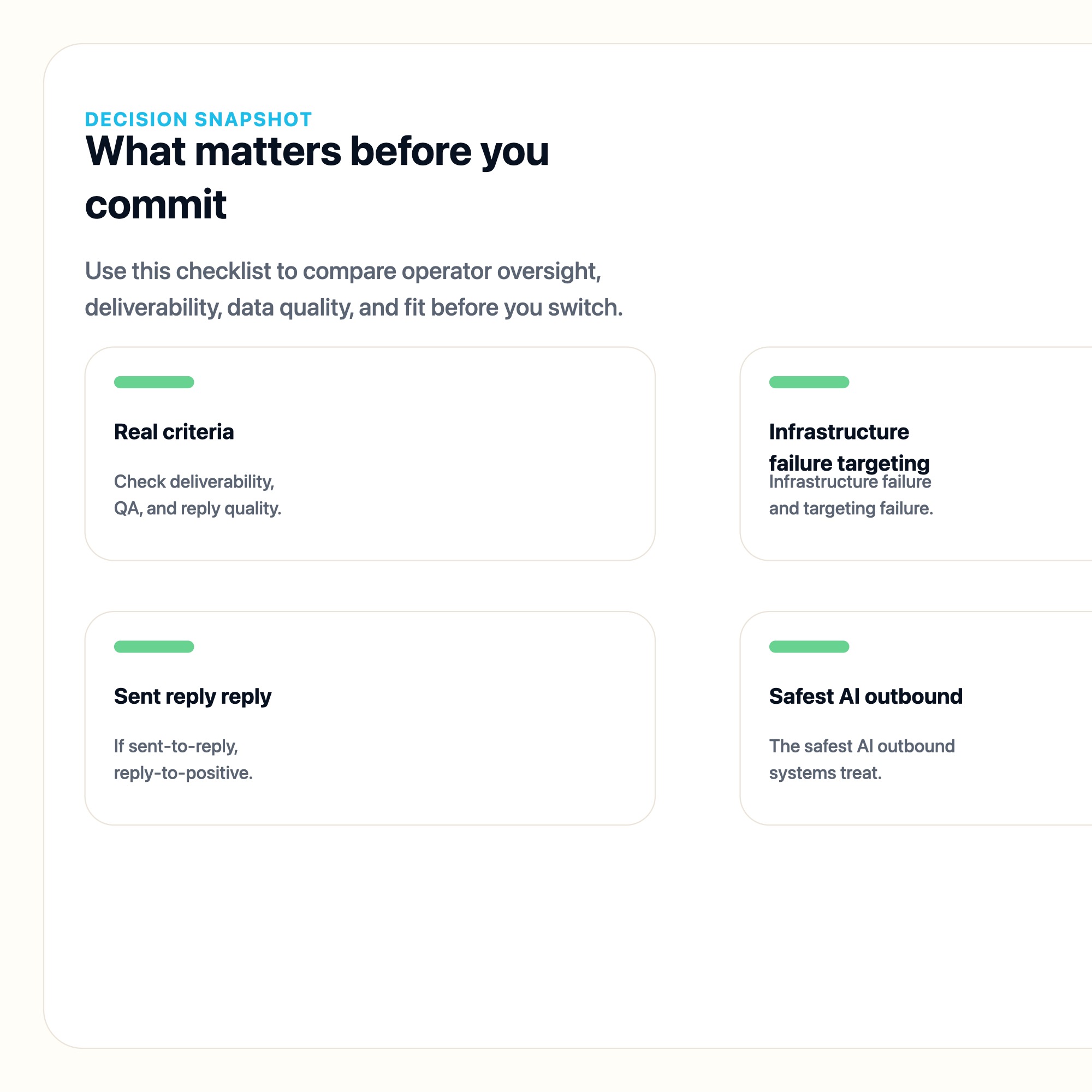
- Deliverability usually breaks because teams scale weak infrastructure, weak targeting, or weak QA—not because they used AI.
- Infrastructure failure and targeting failure are different problems. Good teams diagnose them separately, then fix how they interact.
- If sent-to-reply, reply-to-positive, and positive-to-meeting start slipping, the answer is usually tighter controls, not more volume.
- The safest AI outbound systems treat deliverability like an operating system: owned, monitored, and reviewed by humans.
- Convert’s wedge is simple: deliverability-first AI outbound with human QA, not unattended automation that looks productive on a dashboard.
Most teams blame the wrong layer first
This is where the confusion starts.
A system can look fine while it is getting weaker. Emails are still going out. Replies still come in. Meetings may still get booked. So the team blames the visible layer first: the copy, the sequencer, the prompts, the tool.
Sometimes that is right. A lot of the time, it is not.
The break usually started earlier. Sender infrastructure got pushed too hard. The list got broader than the proof could support. AI-generated messaging went live without enough review. Activity stayed visible, but the quality underneath started slipping.
That is why deliverability gets misdiagnosed so often. The symptom shows up in outreach. The failure usually starts in operations.
There are two different failure modes
The cleanest way to evaluate an AI SDR system is to separate infrastructure failure from targeting and copy failure.
They compound each other, but they are not the same problem. Teams get into trouble when they treat them like one bucket.
1. Infrastructure failure
This is the sender-health side.
It usually shows up as:
- too few domains or inboxes for the send volume
- rushed or inconsistent warm-up
- incomplete or loosely maintained SPF, DKIM, or DMARC
- little placement testing
- weak blacklist monitoring
- volume increases without enough buffer
When this layer breaks, even decent messaging can underperform. The system gets fragile. A small mistake costs more. Testing gets harder. Scaling gets riskier.
That is why Convert’s public operating model matters here. The Convert playbook describes a more deliberate setup: roughly 10 domains, 100 inboxes, and a 14-day warm-up ramp from 5 to 50 sends per day. That is not just a setup note. It is what it looks like when deliverability is treated like infrastructure instead of wishful thinking.
2. Targeting and copy failure
This is the relevance side.
It usually shows up as:
- ICPs broadening because the team wants more volume
- account lists that technically match filters but are still weak-fit
- proof that is true but not buyer-relevant
- personalization that looks custom but reads generic
- claims that sound polished without saying much
- copy optimized for output instead of reply quality
When this layer breaks, engagement weakens. Once engagement weakens, sender reputation gets less support from actual buyer response. That is how a relevance issue turns into a deliverability issue.
This is also where a lot of AI SDR positioning goes off course. It treats the problem like a throughput problem. More volume. More touches. More automation.
But weak-fit volume is still weak-fit volume. AI does not fix that.
What infrastructure failure looks like in the real world
A lot of teams say they have a deliverability problem when what they really mean is that results got softer and they do not know why.
That is too vague to be useful. Here is what the infrastructure layer usually looks like when it starts to break.
Thin sender capacity
This is one of the most common break points.
If a team expects a small sender footprint to carry serious outbound volume, the motion gets brittle fast. There is less room for careful ramping, less room for testing, and less room for mistakes.
More domains and inboxes are not just about scale. They are about control.
That is why Convert’s public setup details matter. A system built around about 10 domains and 100 inboxes gives a team more room to ramp, rotate, and manage health than a thin setup trying to punch above its weight.
One-time setup thinking
A lot of teams configure sender basics once, then mentally move on.
That is usually where the drift begins.
The Convert playbook calls out SPF, DKIM, DMARC, placement checks, and blacklist monitoring. That is the right frame. Sender health is not a one-time task. It is maintenance.
If nobody is reviewing that layer consistently, the system can weaken for weeks before anyone names the actual cause.
Volume getting ahead of readiness
This is the classic scaling mistake.
The motion shows a little early traction, so the team pushes harder. More inboxes get added loosely. Warm-up discipline slips. Monitoring gets lighter. Volume rises before the operating system is ready for it.
From the outside, the motion can still look sophisticated. Inside, it is getting harder to trust.
What targeting and copy failure looks like in the real world
This side gets underdiagnosed because it is less technical. It should not.
A lot of deliverability damage starts here.
Weak-fit lists
If the list is wrong, the copy does not matter as much as the team wants it to.
The message may look polished. The workflow may look advanced. But if the account should not have been in the sequence in the first place, the system is training itself on weak response conditions.
This is the same operator lesson that shows up in other outbound problems. More volume usually does not fix a bad path. It just scales the waste.
Weak proof
Most teams use the wrong proof in outbound.
They reach for the biggest logo or the broadest claim. But the best proof is usually the proof that feels closest to the buyer’s world.
That is not just a messaging point. It affects deliverability too. When the proof feels generic, engagement drops. When engagement drops, the sender layer gets less support from actual buyer response.
A simpler way to say it: relevance is part of deliverability.
Fake personalization
This is where AI creates false confidence.
A message can mention a role, a company, or a surface detail and still feel interchangeable. That is not real personalization. It is formatting.
Teams often mistake that for message quality because it looks customized at first glance. But buyers do not reward surface detail by itself. They respond when the message shows fit, judgment, and proof.
Why human QA matters more than most teams admit
This is the layer a lot of AI SDR systems are missing.
The model looks good. The prompts look good. The workflow looks good. So the team lets the system run with light supervision.
That is usually where quality debt starts piling up.
Human QA matters because it catches the things automation is bad at catching on its own:
- claims that sound sharp but are commercially empty
- accounts that fit a filter but are still poor targets
- proof that is true but badly matched to the buyer
- personalization that reads custom but feels generic
- reply patterns that suggest the motion is drifting
This is where Convert’s wedge is more than branding. Public materials describe AI recommendations being reviewed before deployment. That is a real control layer between generation and live outreach.
Without that layer, teams often learn too late. They find out after the market has already started giving weak signals back.
What healthier AI SDR systems do differently
Healthy systems usually feel less flashy than broken ones.
They are clearer. More owned. More measurable.
They instrument the right ratios
Convert’s public materials reference three operating ratios:
- sent-to-reply
- reply-to-positive
- positive-to-meeting
Those are useful because they help locate the break.
If sent-to-reply drops, the issue may be sender health, targeting quality, or message relevance. If reply-to-positive falls, the problem is often proof, fit, or claim quality. If positive-to-meeting weakens, the issue may sit later in qualification or meeting quality.
That is more useful than staring at a dashboard that mainly says activity happened.
They keep ownership obvious
A healthy system can answer simple questions fast.
Who owns sender health? Who reviews target quality? Who checks live messaging before it compounds? Who watches the ratio trend line after launch?
If those answers are fuzzy, the system is weaker than it looks.
They treat deliverability like an operating system
This is the simplest distinction in the whole article.
Healthy teams do not treat deliverability as a setup checklist. They treat it like an operating system that needs maintenance, instrumentation, and judgment.
That is also a good place for a visual. A simple healthy-vs-risky comparison grid works well here because founders can scan it fast and see whether their system is controlled or just active.
Healthy vs risky signals
| Healthy signals | Risky signals | | — | — | | sender infrastructure is maintained over time | sender setup is treated as finished after day one | | current volume matches current capacity | too few inboxes are expected to carry too much load | | targeting is tight enough to support relevant messaging | list breadth keeps expanding to feed volume goals | | proof feels specific to the buyer’s world | proof is generic, oversized, or weak-fit | | human QA exists before live deployment | the system runs mostly unattended | | ratio health is reviewed alongside activity | dashboards look busy, but nobody can explain quality clearly |
Where managed execution helps
An internal team can absolutely run AI outbound well.
But only if it has the infrastructure, the ownership, the QA discipline, and the patience to run this like an operating system instead of a software subscription.
That is why managed execution can be the better fit for a lot of teams. Not because internal teams are incapable. And not because more AI is the answer.
It is usually better when the control layer is better.
If you want a practical outside read on whether your outbound system is healthy or just busy, book time with Convert.
Want the operator view?
If you want the exact setup we’d use for your outbound, book time with us. We’ll show you what to fix first, what to automate, and where human QA still matters.