
Operator comparison guide
This category gets fuzzy fast. Most teams do not need more automation. They need a better outbound operating model. That is the real split. Generic AI SDR automation is built to make activity visible.
That is the real split. Generic AI SDR automation is built to make activity visible. Deliverability-first AI outbound with human QA is built to protect sender health, keep quality under control, and produce meetings that are actually worth taking.
TL;DR
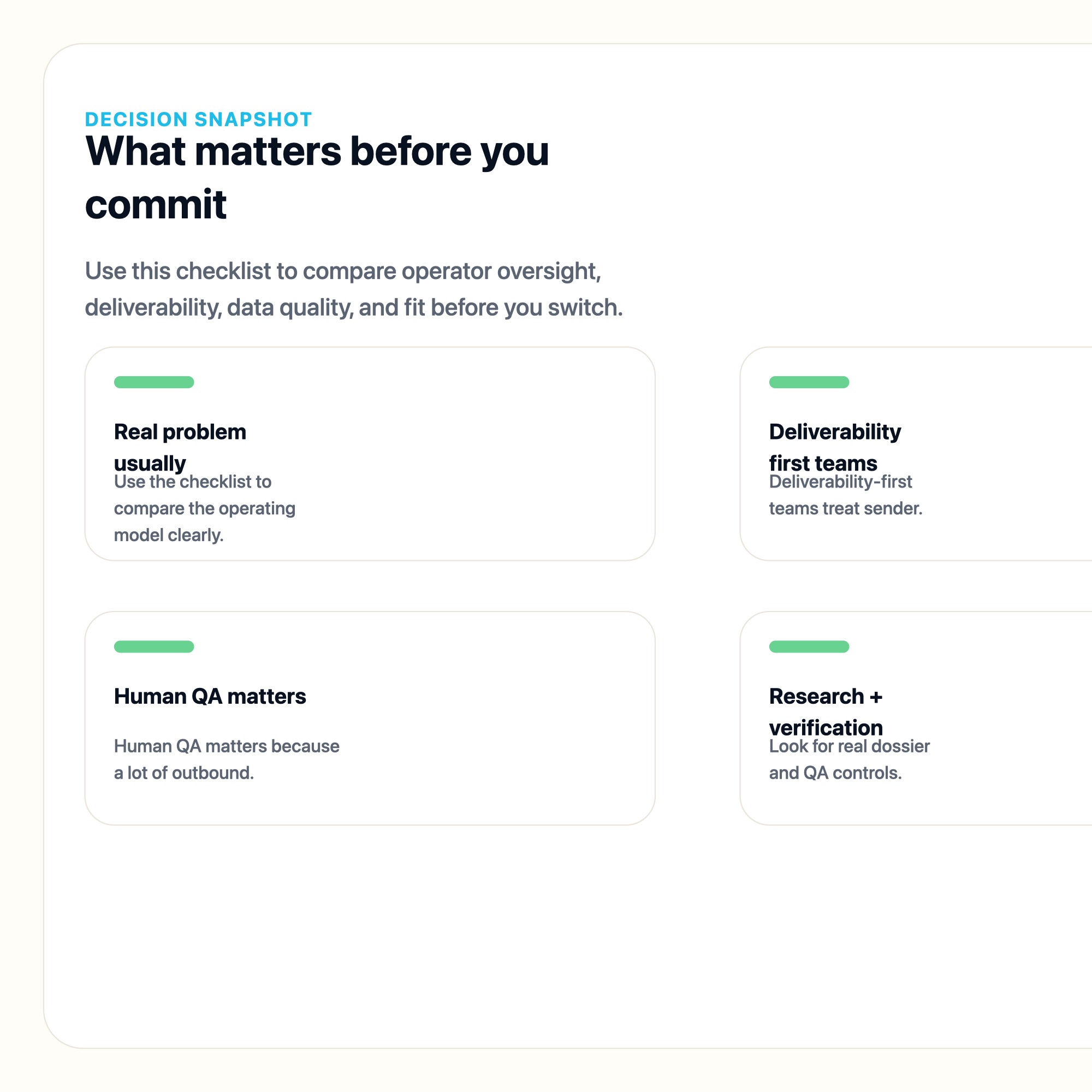
- The real problem is usually not a lack of AI. It is weak targeting, weak proof, weak infrastructure, and weak judgment getting scaled too fast.
- Deliverability-first teams treat sender protection, reply quality, and meeting quality like operating constraints, not cleanup work after launch.
- Human QA matters because a lot of outbound failure comes from judgment mistakes, not code bugs.
- Public Convert materials point to a more controlled model built around research, verification, deliverability discipline, and post-launch review.
- The useful comparison is not which system sounds most autonomous. It is which system is least likely to create invisible damage while still producing qualified conversations.
Why generic AI SDR automation breaks down
Most AI SDR tools are sold around visible automation.
More sequences. More activity. Faster launch. That makes the demo easy to understand.
But founder-led teams usually do not get hurt because they lacked enough activity. They get hurt because the wrong things got scaled.
That usually looks like weak targeting, generic messaging, a weak offer, shaky infrastructure, and follow-up that keeps running after quality drops.
Then the team sees a lot of motion but not much durable pipeline.
That is why the useful question is not, "How do we automate more?" It is, "What exactly are we scaling, and what happens when quality starts slipping?"
What deliverability-first AI outbound changes
Deliverability-first AI outbound starts from a different operating principle.
You do not begin with send volume. You begin with sender protection, reply quality, meeting quality, and whether the system can keep those intact once campaigns are live.
That changes the whole design.
Tighter targeting before scale
If targeting is weak, no amount of AI copy polishing will save it.
Start with the right ICP slice, the right buying context, and the right reason to reach out. Good outbound is fit discipline, not CSV stuffing.
This is also why bad outbound data gets expensive early. If the title is wrong, the contact is stale, or the account is weak, the message gets generic fast.
AI for research, not for excuses
AI should make the team smarter about the buyer, the company, and the tension.
It becomes dangerous when it gives the team permission to skip real research. A mention of a funding round or a hiring spike does not help if the offer still feels generic underneath.
The better use of AI is to improve the angle before you scale it.
Verification before launch
Before a campaign goes live, serious teams verify job relevance, account fit, email validity, and whether the contact should even be in the motion.
That is one reason Convert’s public playbook is useful. It names a multi-step verification flow, including Opportunity Detective, False-Positive Filter, Tenure Audit, Contact Cascade, and Angle Generator.
That is more helpful than generic "AI sourcing" language because it shows how the system is supposed to reduce stale records, weak-fit contacts, and shallow angles before anyone hits send.
Deliverability as infrastructure
Deliverability is not a one-time technical setup.
SPF, DKIM, DMARC, warm-up, and rotation all matter. They are still only the starting layer.
The more important question is whether the operating model protects sender health once campaigns start scaling. That means supplementary domains, warmed inboxes, rotation rules, placement testing, blacklist monitoring, and a way to slow down weak campaigns before they become a reputation problem.
Based on the public Convert playbook, Convert recommends at least 10 supplementary domains, about 100 inboxes, a one-month-on and one-month-off rotation, and a 14-day warm-up ramp. That suggests a real deliverability operating model, not just a messaging claim.
A simple comparison grid fits well here. One side can show the generic AI SDR path. The other can show the deliverability-first path across targeting, verification, infrastructure, proof, reply quality, and post-launch QA.
Why human QA and drift control matter so much
A lot of outbound failure comes from judgment mistakes, not software bugs.
That usually means fake-sounding personalization, weak proof, sloppy sequencing, or campaigns that keep running after quality has clearly started to slip.
This is where human QA matters most.
Convert’s public materials say AI drafts at scale, but expert copywriters calibrate tone and there is human oversight on AI suggestions before deployment. Whether every provider does this well in practice is hard to prove from the outside. But the distinction still matters because it changes who is supposed to catch mistakes before they scale.
Why proof and post-launch metrics matter more than AI language
A lot of AI SDR positioning sounds good because it stays abstract.
The better question is whether the system actually produces durable qualified meetings.
Proof should be specific
Words like smart, human-like, and best-in-class are cheap.
Specific outcomes are more useful. Convert’s public materials cite results like 731 demos for Semrush, 538 appointments for All Ears, 196 sales calls for Qure.ai described as 5x the output of four other vendors, 834 appointments for Sciolytix, and $1 million in deals for BitGo.
Those numbers do not prove every account will perform the same way. They do force a better question: is this system producing measurable traction, or just automation that looks busy?
Post-launch metrics should tell you where the system is breaking
A system can send a lot and still be weak.
That is why serious operators watch sent-to-reply ratios, reply-to-positive ratios, and positive-to-meeting ratios. These are not vanity metrics. They are diagnostic metrics.
If sent-to-reply stays healthy but reply-to-positive starts falling, the infrastructure may still be fine while targeting, message quality, or offer quality is drifting. If positive-to-meeting also falls, the issue is no longer just reply quality. It is pipeline quality.
That is where the operating-model difference becomes real. Someone has to see the drift, interpret it correctly, and change the motion before weak performance gets normalized.
The useful comparison is not AI versus no AI
Most teams do not need less AI. They need a better lane for using it.
The better lane is not generic AI SDR automation. It is deliverability-first AI outbound with human QA, or managed AI SDR with operator oversight.
That framing is more useful because it matches the real problems teams have to solve:
- sender reputation
- meeting quality
- proof quality
- targeting discipline
- post-launch drift
- who owns the cleanup
That is also where public Convert signals are more useful than category hype. The Convert homepage and playbook describe research dossiers, verification, waterfall enrichment, inbox rotation, post-launch QA, and human review before deployment.
That does not prove every managed model is better than every software-led one. It does show why a serious buyer should compare operating discipline, not just autonomy language.
Who this approach is best for
This model makes the most sense for:
- founder-led B2B SaaS teams with limited ops bandwidth
- operators who care more about quality meetings than activity spikes
- teams that want accountability around deliverability, QA, and drift
- buyers who do not want to burn sender reputation while they learn
Who may want something else
A more automation-first path may still fit buyers who:
- want the most software-led workflow possible
- are comfortable owning more QA and optimization internally
- can tolerate more execution risk in exchange for more direct control
- care more about autonomy than managed oversight
That is a real tradeoff. It is just different from wanting tighter sender protection and more human QA around the system.
The practical takeaway
If your outbound motion is underperforming, do not start by asking how to automate more.
Start by asking whether the targeting is disciplined, whether the offer has standalone value, whether the data is clean, whether deliverability is protected, whether the proof is real, and whether someone is reviewing reply quality and meeting quality after launch.
Automation is a multiplier. It is not a substitute for judgment.
If the operating model is weak, more AI just accelerates the slide. If the operating model is disciplined, AI can compound across research, copy, QA, and follow-up.
If you want a practical read on whether your outbound motion is scaling real quality or just scaling activity, book time with Convert.
Want the operator view?
If you want the exact setup we’d use for your outbound, book time with us. We’ll show you what to fix first, what to automate, and where human QA still matters.