
Operator comparison guide
If you are choosing between AI SDR software and a lead gen agency, most comparisons miss the real decision. The question is not which option sounds more modern.
That is the part that gets expensive when teams get it wrong.
TL;DR
- The useful comparison is not just software versus agency. It is who owns the outbound motion after launch.
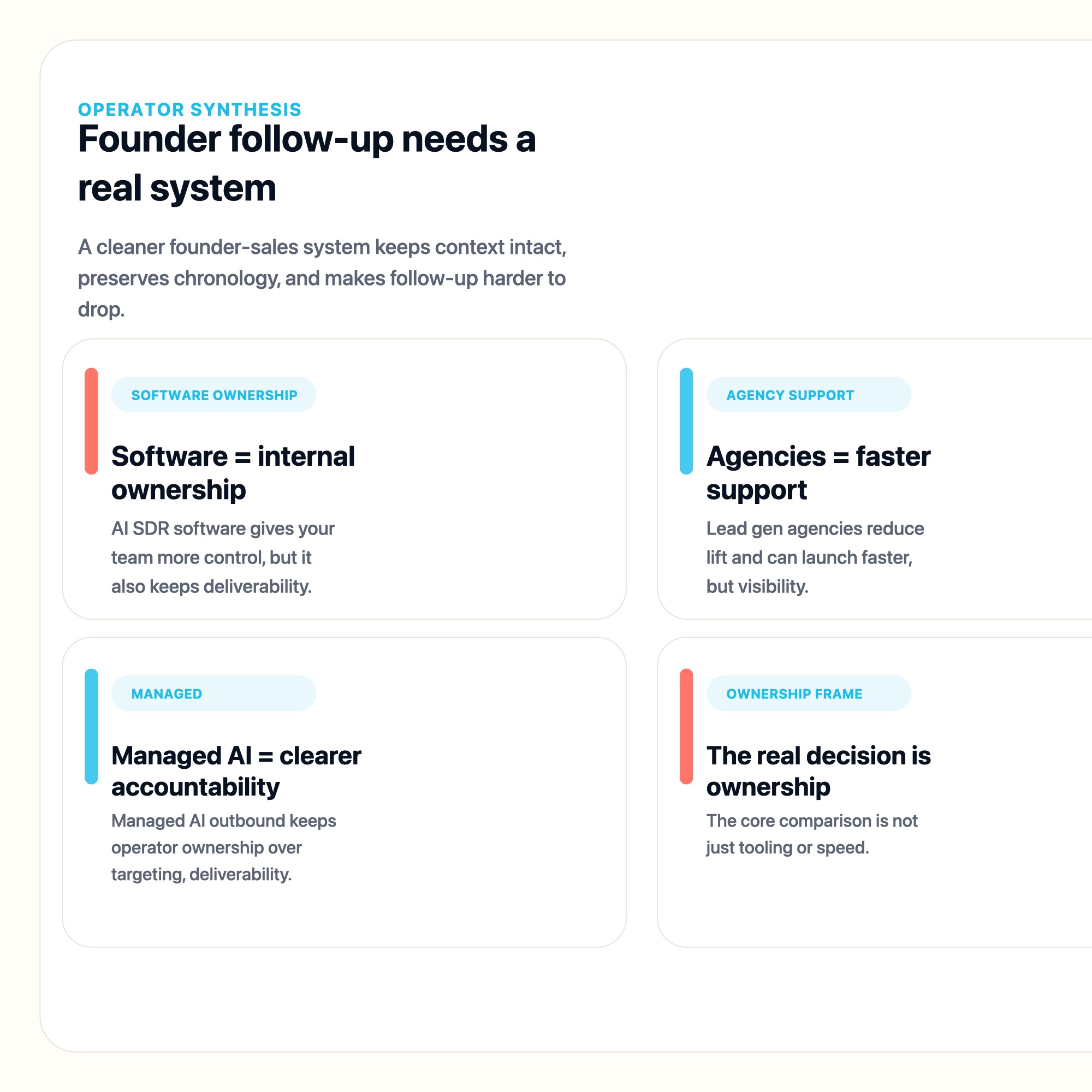
- AI SDR software is usually best for teams that already have strong outbound operators and want more control.
- Lead gen agencies are usually best for teams that need execution help quickly and do not want to build the machine themselves.
- Both models can fail when deliverability, QA, and meeting quality have no clear owner.
- At Convert.ai, our model is different from both: deliverability-first AI outbound with human QA and managed AI SDR with operator oversight.
Who this comparison is for
This page is for founders, sales leaders, and RevOps operators trying to pick the right outbound model for a lean B2B team.
It is especially relevant if you are trying to avoid three common outcomes:
- paying for activity instead of qualified meetings
- damaging sender reputation while you test
- ending up with a motion that looks active but drifts underneath
A lot of teams do not fail because they picked a bad tool. They fail because they bought the wrong ownership model.
The real buying lens
Most teams do not need another generic debate about software versus services. They need a clean answer to one question:
When performance moves, who owns the fix?
That matters more than feature lists.
If reply quality drops, who figures out whether the issue is targeting, deliverability, proof, copy, or inbox health?
If meetings are getting booked but the quality is weak, who catches that and changes the motion?
If domains get soft, who is accountable for fixing the operating layer before pipeline quality slips?
Those are ownership questions.
That is why this category gets confusing. AI SDR tools and lead gen agencies get compared like they are interchangeable. They are not. They leave very different burdens with the buyer.
What each model actually is
AI SDR software
AI SDR software usually means your team buys a platform that helps with some mix of:
- account research
- enrichment
- routing
- personalization
- drafting
- sequencing
- reply handling
The upside is control.
Your team owns the motion. That can be a real advantage if you already have outbound judgment in-house and want the flexibility to shape the system yourself.
The downside is also control.
Your team still has to own:
- deliverability setup and monitoring
- targeting quality
- proof quality and message relevance
- QA and optimization
- meeting quality review
If you already have a strong operator or outbound leader, AI SDR software can be the right fit. If you do not, the system can look productive while the hard parts go unmanaged.
Lead gen agency
A lead gen agency usually means you hire an external team to handle some mix of list building, copy, outbound operations, and meeting booking.
The upside is speed and lower internal lift.
You do not have to build the full machine in-house. That can be the right trade if you need help fast and your team does not want to own every moving part.
The downside is visibility.
The motion may move, but the buyer often has less direct visibility into how targeting, copy, deliverability, and optimization are actually being handled day to day.
That does not make agencies bad. It just means the tradeoff is real.
Some teams care more about speed. Others care more about knowing exactly how the system is being run. The better fit depends on which burden you are willing to carry.
Managed AI outbound with operator oversight
This is where Convert.ai fits.
Our model is not AI-only and it is not generic agency execution either. The point is a managed outbound system where AI does useful work, but there is still real operator ownership over targeting, deliverability, reply quality, and meeting quality.
That is why our wedge stays specific:
- deliverability-first AI outbound with human QA
- managed AI SDR with operator oversight
A lot of outbound problems are not caused by a lack of automation. They are caused by weak ownership around the parts that drift first.
Where each model wins and loses
There is no universal winner here. The better comparison is where each model is strongest and where it tends to break.
AI SDR software is strongest when your team already knows how to run outbound
If your team already has strong outbound judgment, AI SDR software can be a very good fit.
You get control. You can shape workflows more directly. You are not dependent on an outside execution partner to hold the machine together.
But the risk is simple: if the team does not really own deliverability, QA, optimization, and meeting quality, the software does not solve that problem.
It just gives the team a faster way to run a weak system.
Lead gen agencies are strongest when speed matters more than full internal ownership
Lead gen agencies can make sense when the company needs execution help quickly and does not want to build the outbound function from scratch.
That can be the right call. A lot of teams simply do not have the time or internal talent to assemble the tooling, workflows, and operating discipline themselves.
The risk is that the reporting can look acceptable while the real operating decisions stay opaque.
If you cannot get clear answers on targeting logic, deliverability ownership, QA standards, and why meetings are converting or not converting, you are relying on outputs without enough operating visibility.
Managed AI outbound stands apart when you want leverage without losing operating control
This is the middle ground many teams actually want.
They do not want to build everything in-house. They also do not want to hand the motion to a black box.
They want execution, but they also want someone to actually own the system.
That is where managed AI outbound with operator oversight stands apart.
The point is not to maximize activity. The point is to run the motion in a way that protects sender health, catches weak-fit messaging, and keeps meeting quality visible instead of hiding behind top-line numbers.
Why Convert.ai is different
At Convert.ai, we do not treat deliverability like a setup task you finish once. We treat it as part of the operating system.
That shows up in our playbook and our public materials.
Deliverability is part of the system
Our public operating model describes a more deliberate outbound posture, including:
- 100+ warmed inboxes
- a playbook built around at least 10 domains and roughly 100 inboxes in total
- a 14-day warm-up ramp from 5 to 50 sends per day
- SPF, DKIM, DMARC, placement testing, and blacklist monitoring
That matters because deliverability problems are rarely just about DNS. They are usually a systems problem.
Weak targeting, weak copy, weak proof, or weak QA can all show up later as deliverability pain. If nobody owns that full stack, the motion can look fine until it does not.
Human QA is still part of the edge
We also describe AI recommendations being human-reviewed before deployment.
That is not a cosmetic detail.
Weak-fit targets, shaky claims, and bad proof often slip through when nobody is reviewing the output with operator judgment. That is one reason we keep our positioning tight around human QA instead of generic autonomy language.
Meeting quality is part of the operating view
Our public materials also describe QA and performance monitoring around ratios like:
- sent-to-reply
- reply-to-positive
- positive-to-meeting
That is a better operating lens than activity alone.
A lot of outbound systems can generate volume. Fewer systems are built to show whether the meetings are actually useful and whether the motion is getting stronger or weaker over time.
We also reference transcript-powered feedback loops through tools like Fathom and Fireflies. That matters because the system should learn from real conversations, not just dashboard summaries.
A simple way to compare the options
A visual comparison works well here because the tradeoffs are easier to see side by side than buried in paragraphs.
A simple comparison grid in this section should show:
- deliverability ownership
- human QA
- setup burden
- meeting quality visibility
- post-launch accountability
The point of that visual is not to force a fake winner. It is to make the ownership tradeoffs easy to scan.
What to ask before you choose
If you are evaluating these models, ask the questions that expose the real operating burden.
1. Who owns deliverability?
Not just setup. Ongoing ownership.
Who notices if inbox health slips? Who changes the motion before a domain problem turns into a pipeline problem?
2. Who owns QA?
Who reviews targeting, proof, claims, and message quality before weak output gets into the market?
3. Who owns meeting quality?
Are you just buying booked calls, or is someone responsible for whether those meetings are worth taking?
4. Who can explain why the motion is working?
If the answer is vague, the system is weaker than it looks.
That is true whether you are buying software, hiring an agency, or evaluating a managed outbound partner.
Who should choose each model?
Choose AI SDR software if:
- you already have strong outbound operators in-house
- you want more control than service-led execution gives you
- your team can own deliverability, QA, and optimization without outside help
Choose a lead gen agency if:
- you need execution help quickly
- your team does not want to build the system internally right now
- you are comfortable with lower internal lift and somewhat less operating visibility
Choose managed AI outbound with operator oversight if:
- you want leverage without losing visibility into the system
- you care about deliverability, QA, and meeting quality as operating responsibilities, not just outputs
- you want a partner that does not treat outbound like a black box or a tool license
FAQ
Is AI SDR software better than a lead gen agency?
Not automatically.
AI SDR software is often better for teams with strong internal outbound ownership. A lead gen agency is often better for teams that need execution help quickly and do not want to assemble the whole motion themselves.
The better option depends less on category labels and more on who can actually own the work after launch.
When is a lead gen agency the better fit?
Usually when the team needs outbound support fast and does not want to build the full system in-house.
That can be a smart trade if speed matters more than full operating visibility.
When is AI SDR software the better fit?
Usually when the company already has strong internal operators and wants more direct control over the motion.
If your team cannot really own the workflow, the software will not fix that gap by itself.
What makes managed AI outbound different?
The difference is ownership.
AI is doing useful work, but there is still real human ownership over targeting, deliverability, reply quality, and meeting quality.
That is the commercial distinction that usually matters most in practice.
If you want a practical read on which model fits your team best, book time with us.
Want the operator view?
If you want the exact setup we’d use for your outbound, book time with us. We’ll show you what to fix first, what to automate, and where human QA still matters.