
Operator comparison guide
Most founder-led sales problems do not start with bad copy. They start when follow-up depends on memory, scattered tabs, or one person's private context.
FounderOS Should Make Follow-Up Impossible to Drop
Most founder-led sales problems do not start with bad copy.
They start when follow-up depends on memory, scattered tabs, or one person's private context.
That is the real reason revenue gets dropped. Not because the founder forgot the company mattered. Not because the lead was weak. Because the system made it too easy for a real conversation to disappear between email, notes, CRM rows, and "I will get to that later."
If you are serious about founder-led sales, your operating system should make that nearly impossible.
The wrong way to run follow-up
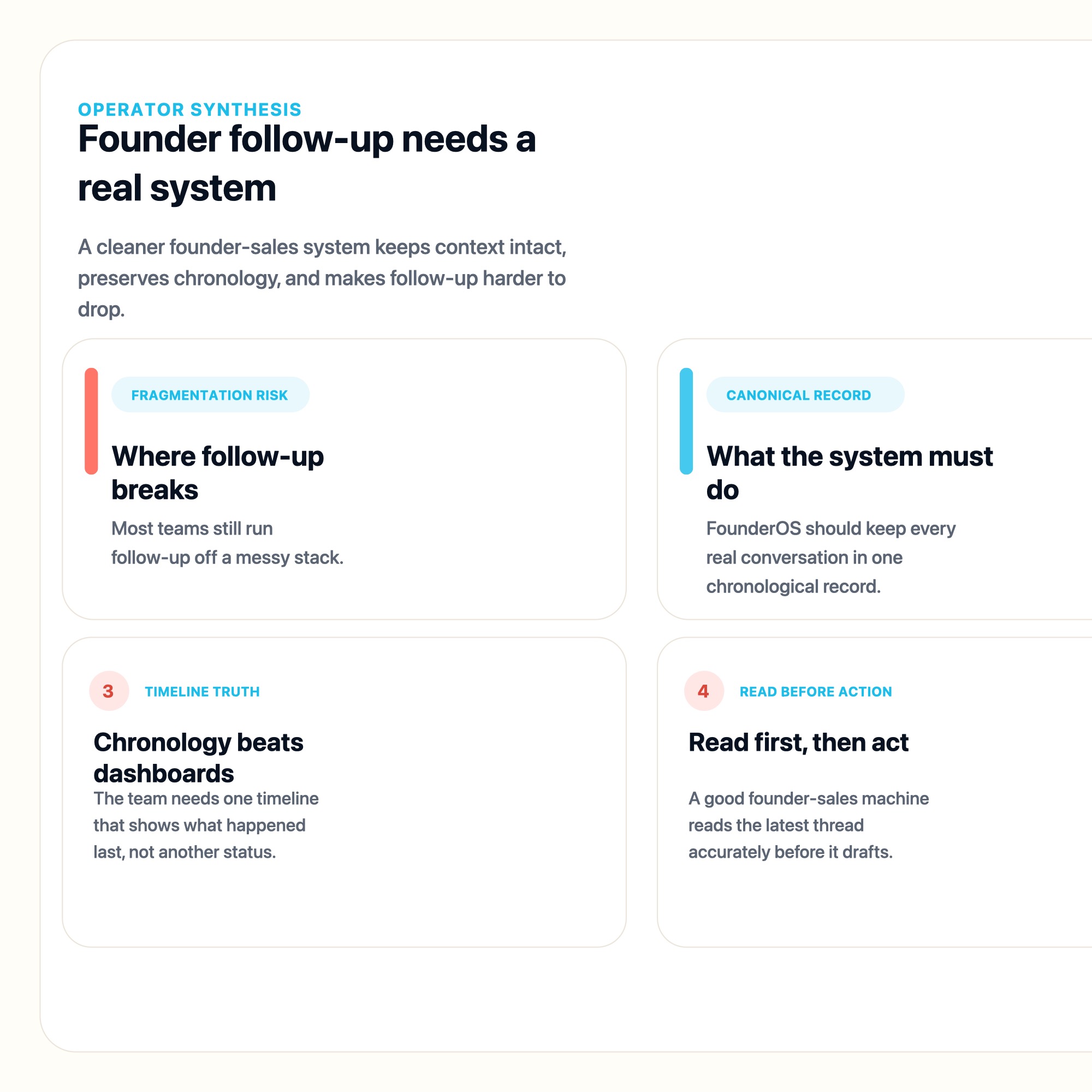
Most teams still run follow-up off a messy stack:
- Gmail has the real thread
- the CRM has partial notes
- meeting transcripts live somewhere else
- draft replies live in another tool
- the founder remembers the real nuance in their head
That setup works until volume rises a little, a thread forks, a transcript lands late, or someone asks a very normal question like:
"What is the latest thing they said?"
Then everything gets slower. The founder has to cross-check surfaces manually. Drafting becomes cautious because nobody fully trusts the context. Good leads get delayed. Weak leads get treated like strong ones. The machine starts sounding confident while being wrong.
That is not an outreach problem. That is an operating-system problem.
What FounderOS should do instead
FounderOS should make every real commercial conversation resolve into one trustworthy, chronological record.
That means:
- The lead exists canonically at the contact and company level.
- The latest inbound and outbound thread activity is attached to that record.
- Relevant meeting transcripts and notes are anchored to the same timeline.
- The next action is explicit.
- The founder can override bad classifications without fighting the machine.
When that works, the daily question changes from "what am I missing?" to "which real conversations deserve founder attention right now?"
That is a much better question.
Chronology matters more than dashboards
A lot of sales tooling tries to solve this with more views, more colored statuses, or more reminders.
That helps a little. It does not solve the core problem.
What matters is chronological truth.
The system should know:
- what happened last
- whether it was inbound or outbound
- whether the founder already replied
- whether a draft is waiting on manual approval
- whether the thread is exact, partial, or still weak
Without that, every suggestion is shaky. With that, the machine can be useful without pretending to be autonomous in places it should not be.
That distinction matters.
A good founder-sales machine is read-first, not act-first
One of the easiest ways to break trust is to let the machine treat email like an execution gateway.
That is backward.
For founder-led revenue work, Gmail should usually be an information surface first:
- read the latest thread accurately
- summarize what changed
- bring the relevant notes and transcript context forward
- suggest what to do next
- wait for founder approval before anything sensitive goes out
That is how you get leverage without losing control.
If the machine skips the reading discipline and jumps straight to action, it creates the worst kind of automation: fast, plausible, and wrong.
The real test: can the system survive drift?
The hard part is not making one perfect demo.
The hard part is surviving normal operational drift:
- a WordPress draft exists but the active review package points at the wrong post
- an exact thread exists but one stale surface still says "blocked"
- a transcript search finds a weak match and pretends it is good enough
- a founder says "this is not a real lead" and the system forgets that correction tomorrow
That is where a real operating system earns its name.
It needs guardrails, canonical-first rules, and deterministic fallbacks so one weak helper response does not poison the whole lane.
That is less glamorous than saying "our AI automates follow-up."
It is also what actually works.
What to look for if you are building this internally
If your team is trying to build a founder-sales operating system, do not start by asking how to automate more touches.
Start by asking:
- Where does canonical lead truth live?
- What surface wins when thread data and CRM data disagree?
- Can manual founder corrections persist?
- Can the machine tell the difference between exact thread evidence and partial evidence?
- Are transcripts and notes actually attached chronologically?
- Does the system fail closed when confidence is weak?
Those questions are more valuable than another sequence template.
What this looks like in practice
At Convert.ai, we think the useful version of AI outbound is not "remove the founder."
It is "reduce the amount of brittle, manual glue work between the founder and the real commercial signal."
That means a better system should help with:
- surfacing who genuinely needs follow-up
- recovering the latest thread context quickly
- grounding drafts in the exact conversation when possible
- separating actionable leads from noise
- preserving approval and send boundaries
Done well, that makes founder follow-up harder to drop and easier to trust.
Done badly, it just creates more confident confusion.
The standard worth aiming for
FounderOS should not merely remind you to follow up.
It should make dropped follow-up structurally less likely.
It should preserve chronology. It should preserve context. It should preserve human approval.
And it should keep getting more reliable as the business grows, not less.
That is the bar.
If the machine cannot meet that bar yet, the honest answer is not "autonomous."
The honest answer is: keep tightening the system until the truth surfaces are strong enough to deserve trust.
Want the operator view?
If you want the exact setup we’d use for your outbound, book time with us. We’ll show you what to fix first, what to automate, and where human QA still matters.