
Operator comparison guide
Most AI outbound pages talk about automation. That is usually the easiest part to market and the least useful part to evaluate. The real question is what protects meeting quality once campaigns are live.
The real question is what protects meeting quality once campaigns are live. For Convert, the strongest public case is not just that AI is involved. It is that deliverability-first infrastructure, human QA, and operator oversight show up together.
TL;DR
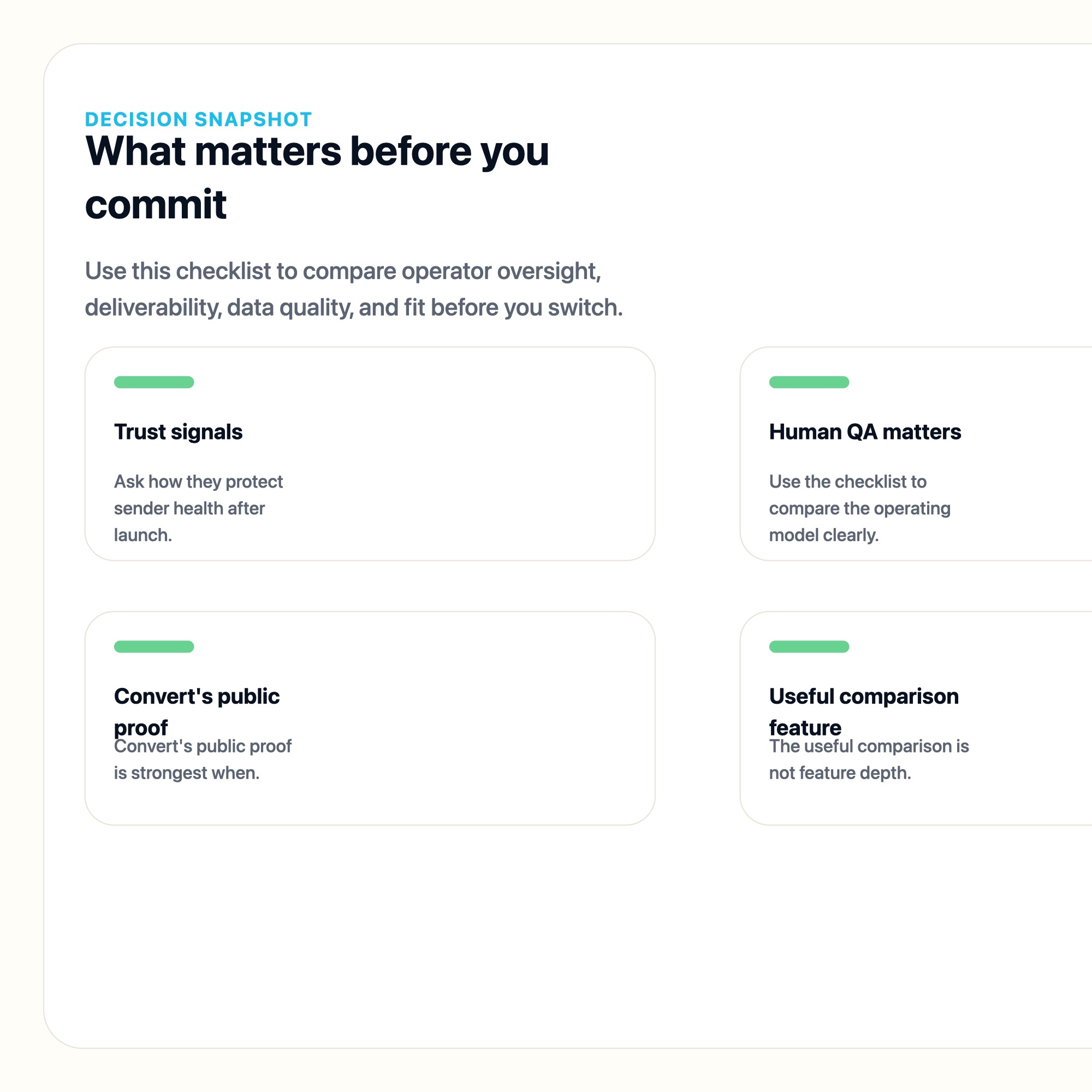
- Deliverability-first outbound is not just a DNS checklist. It is an operating model built to protect sender health before weak performance turns into a bigger problem.
- Human QA matters because many outbound failures come from weak judgment, not just weak tooling.
- Convert's public proof is strongest when operating-model specifics sit next to concrete outcome proof.
- The useful comparison is not feature depth alone. It is whether the system protects meeting quality after launch.
- This model fits teams that care about sender reputation, qualified meetings, and post-launch accountability more than maximum autonomy.
What deliverability-first actually means in practice
Most teams still talk about deliverability as if it starts and ends with setup.
That is too shallow. SPF, DKIM, DMARC, domain setup, and warm-up are necessary. They are not the whole system.
Deliverability-first outbound means the infrastructure is designed to prevent damage before the campaign starts and to catch drift after the campaign is live.
Based on the public Convert playbook and homepage, that includes:
- a supplementary-domain setup built around roughly
10 domainsand100 inboxes 100+ warmed inboxes- a
14-daywarm-up ramp from5to50sends per day SPF,DKIM, andDMARC- inbox placement testing
- blacklist monitoring
- rotation rules tied to sender-health protection
That combination matters because it frames deliverability as prevention, not cleanup.
A simple process visual belongs here. It should show the path from domain and inbox setup, to warm-up, to live monitoring, to post-launch QA. That makes the page easier to scan and the operating model easier to understand.
Why human QA is part of the proof
A lot of outbound problems do not come from missing software. They come from bad judgment at scale.
That usually means weak targeting, bad claims, shallow research, the wrong proof, or campaigns that keep running after the signal quality has already slipped.
This is where human QA matters. Not because "humans are involved" sounds reassuring, but because human review is what stops bad work from scaling.
Convert's public materials describe agentic research, AI support, and human review before deployment. That matters because the useful proof is not abstract. It is practical.
Human QA helps prevent things like:
- weak-fit accounts getting through enrichment
- personalization that sounds relevant but not persuasive
- claims that are too broad or too soft to trust
- copy that technically works but misses buying context
- campaigns staying live after reply quality or meeting quality starts drifting
That is the real distinction between a human-QA model and a more autonomy-first story. The question is not whether AI is drafting. The question is who is responsible for catching mistakes before they become expensive.
Why operating-model proof matters more than feature lists
Most AI outbound positioning is feature-heavy.
That is understandable. Features are easy to demo. But feature lists do not tell a buyer what happens when performance gets messy.
Operating-model proof is more useful because it shows how the system is supposed to hold up under real conditions.
For Convert, the strongest public operating-model proof includes:
- research dossiers built from signals like news, podcasts, and reports
- waterfall enrichment across multiple providers
- human review before deployment
- QA tied to sent-to-reply, reply-to-positive, and positive-to-meeting ratios
- deliverability controls built around warmed inboxes, supplementary domains, testing, and monitoring
Those details matter because they answer the question most buyers actually have: is this just automated activity, or is there a system designed to protect quality?
That is also why this page should not read like a listicle. The value is in showing how the pieces work together, not in stacking buzzwords.
Outcome proof that supports the case
Operating-model proof matters most, but outcome proof still matters.
Without concrete outcomes, the page becomes theory. Without operating-model detail, the page becomes marketing. The stronger public case uses both.
Based on public-safe proof from Convert, examples include:
Semrushwith731 demos setQure.aiwith196 sales calls set, described publicly as5xbetter than four other vendorsTroopHRwith417 meetingsand119 clientsBitGowith$1 million in deals under contractAdeccowith50 enterprise leads generated within a quarter
These examples do not prove every team will get the same result. They should not be presented that way.
What they do prove is that the operating model has public outcome evidence behind it. That makes the wedge more credible than pages that rely only on autonomy language or generic AI claims.
What kind of team this model is best for
This model is strongest for teams that care more about meeting quality and sender protection than raw automation volume.
It usually fits best when the buyer wants:
- qualified meetings, not just more outbound activity
- protection against sender-reputation damage
- human QA over fully autonomous execution
- a managed system with operator oversight
- clearer accountability when campaign quality drifts
It is probably less attractive for teams that mainly want the most software-led workflow possible or want to own more experimentation and QA internally.
That is a real tradeoff. It is better to say it plainly than to pretend one model is right for everyone.
Why these proof points matter
The strongest case for deliverability-first AI outbound is not that it sounds more careful.
It is that the public proof lines up with the risks buyers actually care about: sender health, message quality, meeting quality, and who owns the fix when things slip.
That is why infrastructure discipline, human QA, and operator oversight belong on the same page. Separated, they sound like feature claims. Together, they describe a working model.
If you want a practical read on whether your outbound motion is protecting sender health and producing the right meetings, book time with Convert.
Want the operator view?
If you want the exact setup we’d use for your outbound, book time with us. We’ll show you what to fix first, what to automate, and where human QA still matters.