
Operator comparison guide
A lot of autonomous SDR systems do not break in an obvious way. That is what makes them risky. The dashboard still shows sends. Replies still come in. Meetings still get booked.
The dashboard still shows sends. Replies still come in. Meetings still get booked. So the team assumes the motion is healthy, when human QA might have caught the drift much earlier.
TL;DR
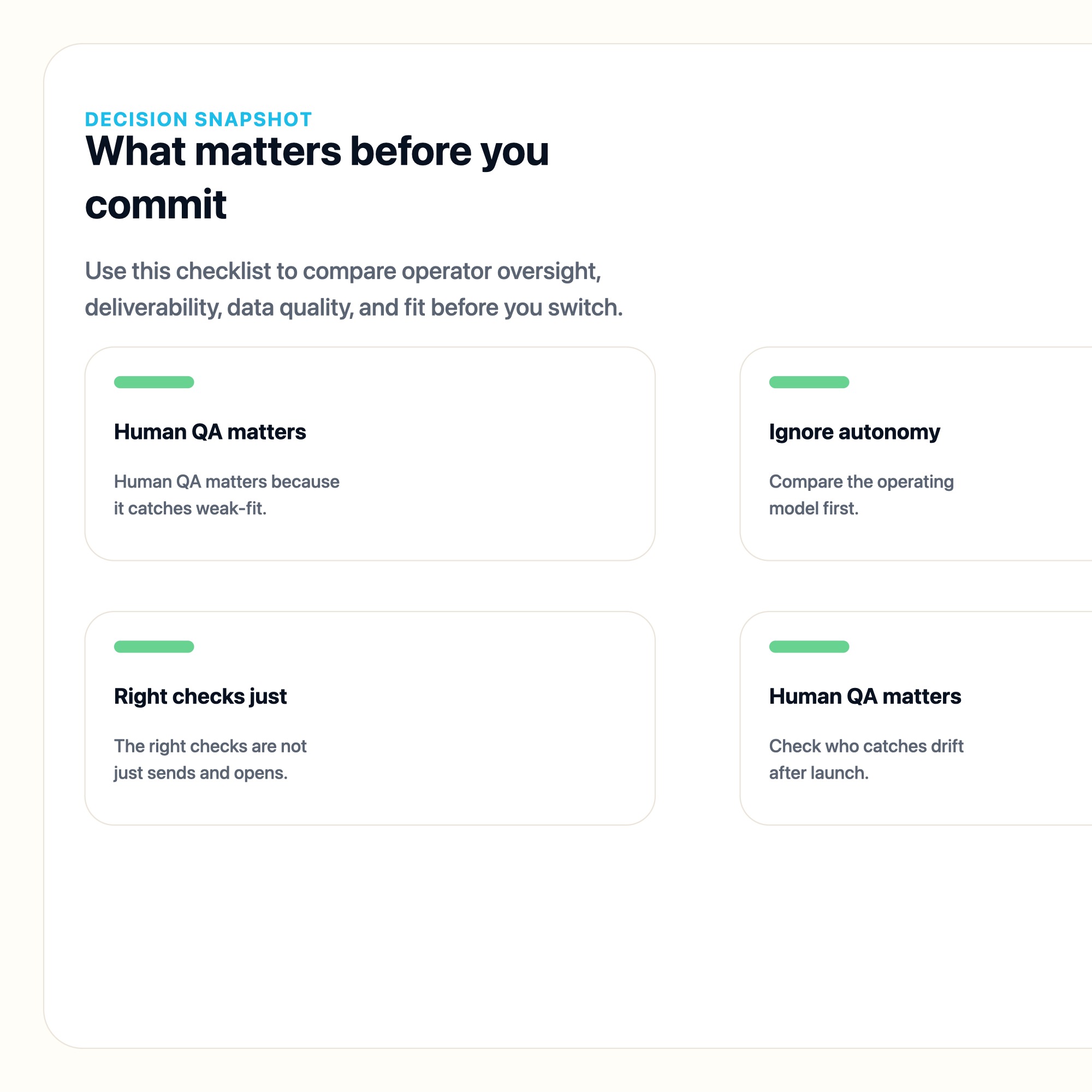
- Human QA matters because it catches weak-fit accounts, weak claims, weak proof, and weak meetings before those problems compound.
- Autonomous SDR systems often fail quietly. Activity can stay high while reply quality, deliverability, and meeting quality get worse.
- The right checks are not just sends and opens. Teams should watch sent-to-reply, reply-to-positive, positive-to-meeting, and meeting quality.
- Convert’s wedge is not anti-automation. It is deliverability-first AI outbound with human QA and managed execution with operator oversight.
- If the main answer to "who is catching drift?" is "the tool," the system is probably weaker than it looks.
Who this page is for
This page is for founders, sales leaders, and RevOps operators trying to figure out whether an AI SDR system is actually working or just producing activity.
It is especially relevant for lean teams. Those teams usually do not have much room for hidden quality problems, weak meetings, or sender issues that get noticed too late.
Why teams over-trust autonomous SDR output
The confusion is understandable.
Most teams do not over-trust automation because they are careless. They over-trust it because the visible metrics keep moving. Sends are up. Replies still exist. Calendars are not empty. So the system looks healthy enough.
But autonomous workflows often fail in the gaps between those metrics.
A dashboard can show that activity happened. It usually cannot tell you whether the right accounts were targeted, whether the proof actually fit the buyer, whether personalization was stale, or whether the meetings being booked are strong enough to create pipeline.
That is where human QA changes outcomes.
The point is not that software is useless. It is that software alone is often too willing to normalize weak output as long as the motion stays active.
The concrete things human QA catches
This is the practical difference between autonomous execution and managed AI SDR with operator oversight.
Human QA catches issues before they turn into deliverability, reply-quality, or meeting-quality problems.
Weak-fit accounts that technically pass the filter
A list can look right in a system and still be commercially wrong.
That is a common failure mode. The account fits the title filter, company-size range, or industry tag, but it is still a weak target in real life.
A dashboard will not flag that well. Human review often will.
This is also where targeting and enrichment errors matter more than people think. If the data is off or incomplete, the workflow may still run, but message quality gets weaker fast.
Personalization that is technically present but commercially weak
This is another quiet failure.
A message can mention a company, a role, or a recent detail and still feel generic. It can look personalized while saying very little that matters.
The same issue shows up in proof selection. Most teams think personalization is about clever copy. Usually it is more about whether the proof actually maps to the buyer's world.
If the proof is stale, misleading, or too broad, human QA should catch that before it goes live.
Claims that are too broad, too aggressive, or not defensible
This is one of the easiest ways for outbound quality to drift.
The draft sounds confident. The system likes it. The output keeps flowing. But the claim is too big, too vague, or too hard to back up.
That creates problems in two places. First, reply quality drops because the message feels less credible. Second, risk rises because weak claims do not usually get safer at scale.
Human QA is useful here because it forces a basic question: would we still be comfortable defending this claim after a few hundred sends?
Noisy reply patterns and low-quality meetings
A lot of teams stop at "we got replies" or "we booked meetings."
That is not enough.
Human QA should catch when replies are getting noisier, less relevant, or less positive even if reply volume still looks acceptable. It should also catch when meetings are technically booked but commercially weak.
That matters because low-quality meetings can make the motion look productive while pipeline quality gets worse.
Deliverability-side warning signs that hide behind acceptable volume
This is where the wedge matters.
Convert’s position is deliverability-first AI outbound with human QA. That means the system is not judged only by whether it can send. It is judged by whether it stays healthy while it sends.
Public Convert materials describe human-reviewed AI recommendations before deployment, ratio monitoring tied to sent-to-reply, reply-to-positive, and positive-to-meeting, plus a broader operating posture that includes warmed inbox infrastructure, placement testing, blacklist monitoring, and human oversight.
That is different from letting an autonomous SDR tool run mostly unattended and assuming the activity dashboard will tell the truth.
What healthy teams watch instead of trusting the dashboard
Healthy teams usually look less impressive on screenshots and more disciplined in the real motion.
They track the ratios that help locate drift:
- sent-to-reply
- reply-to-positive
- positive-to-meeting
- meeting quality, not just booked volume
Those metrics matter because they show where the system is weakening.
If sent-to-reply softens, the issue may be deliverability, targeting, or weak messaging. If reply-to-positive drops, the problem may be proof, fit, or claim quality. If positive-to-meeting falls, the problem may be qualification quality or the usefulness of the meetings being booked.
That is a much better operating view than looking at volume and assuming the rest is fine.
This is also where transcript-powered feedback loops matter. Public Convert materials reference feedback and content loops through Fathom and Fireflies. That matters because good systems should learn from actual conversations, not just campaign output.
Healthy vs risky signals
A simple comparison is often easier to use than a long explanation.
A good visual belongs here: a two-column grid showing what healthy QA signals look like versus risky ones. It helps founders and operators scan the difference quickly.
Healthy signals
Healthy systems usually show patterns like these:
- AI recommendations are reviewed before deployment
- targeting gets checked for commercial fit, not just filter match
- proof is specific enough to matter to the buyer
- claims are defensible at scale
- ratio health is reviewed alongside activity
- meeting quality matters as much as booked volume
- deliverability controls stay visible and owned
Risky signals
Risky systems usually look more like this:
- the team trusts the tool to catch its own drift
- personalization is technically present but thin
- account lists pass filters but produce weak conversations
- reply volume still exists, but positive signal quality slips
- meetings get counted before anyone checks if they are good
- sender health is assumed because volume still looks acceptable
- nobody can clearly say who owns QA across the motion
That is usually the tell. The workflow looks advanced, but the controls are thin.
Where autonomous workflows still have a place
This is not an anti-automation argument.
Autonomous workflows still have a place inside outbound. AI can generate angles, recommend actions, help with research, support targeting, and speed up iteration.
That is useful.
The issue is what happens next.
If the system is making recommendations that still get reviewed by operators before deployment, automation can be a strength. If the system is mostly running unattended, weak output tends to compound quietly.
That is why managed AI SDR with operator oversight is a real distinction. Not because humans need to do every task. Because someone needs to own judgment where the cost of drift is high.
Where managed execution is the better fit
Some internal teams can run this well.
But they usually need strong ownership, clear QA standards, real ratio monitoring, and enough discipline to care about meeting quality and deliverability at the same time.
A lot of teams do not fail because they lacked software. They fail because nobody was reliably catching weak-fit accounts, weak proof, weak claims, noisy replies, and low-quality meetings before those issues spread.
That is usually where managed execution earns its keep.
If you want a practical outside-in read on whether your AI outbound system is healthy or just active, book time with Convert.
Want the operator view?
If you want the exact setup we’d use for your outbound, book time with us. We’ll show you what to fix first, what to automate, and where human QA still matters.