
Operator comparison guide
Most founders compare Clay, 11x, Artisan, and Convert by feature list. That usually leads to a blurry decision. The better question is burden. What kind of burden do you actually want to own after launch?
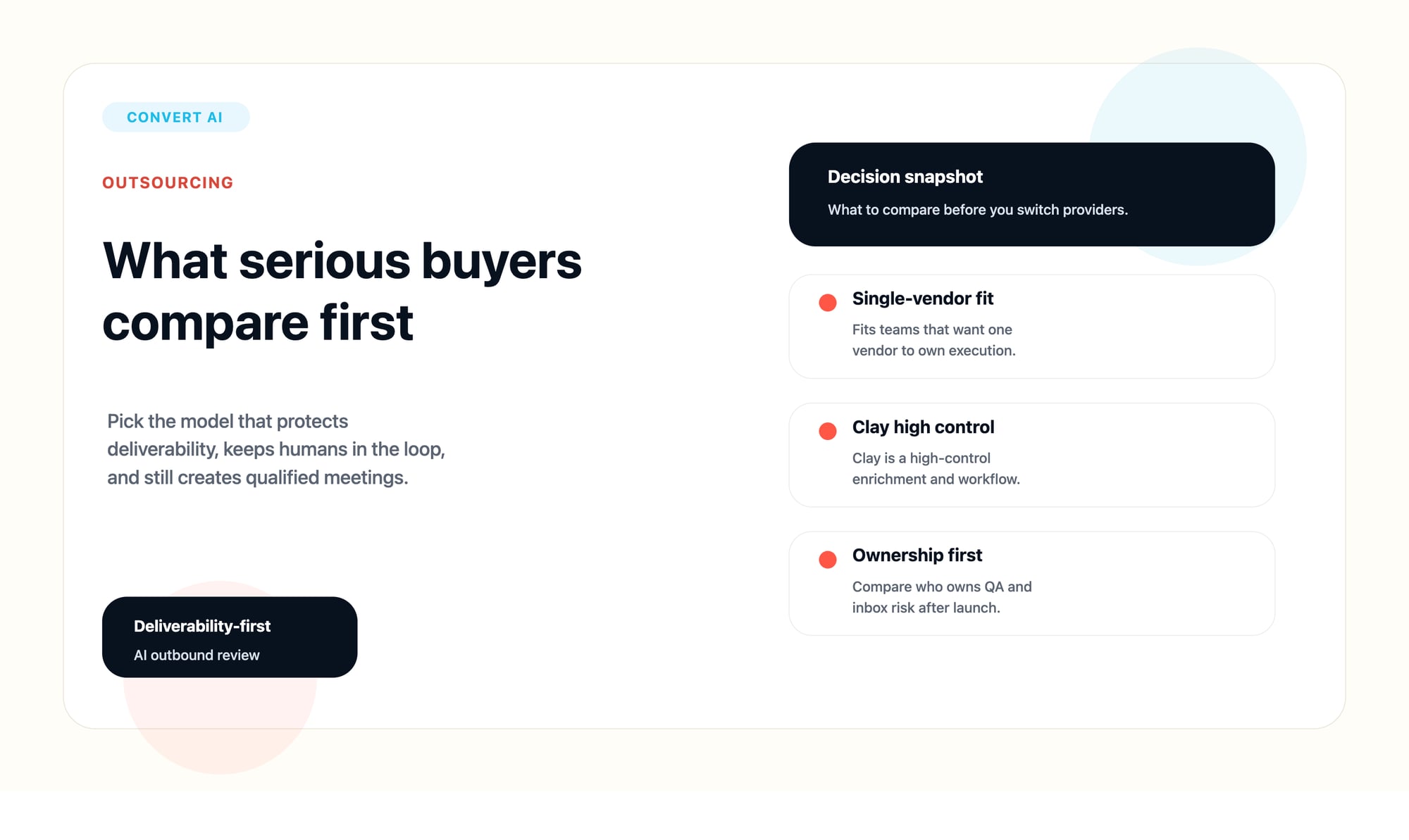
The better question is burden. What kind of burden do you actually want to own after launch?
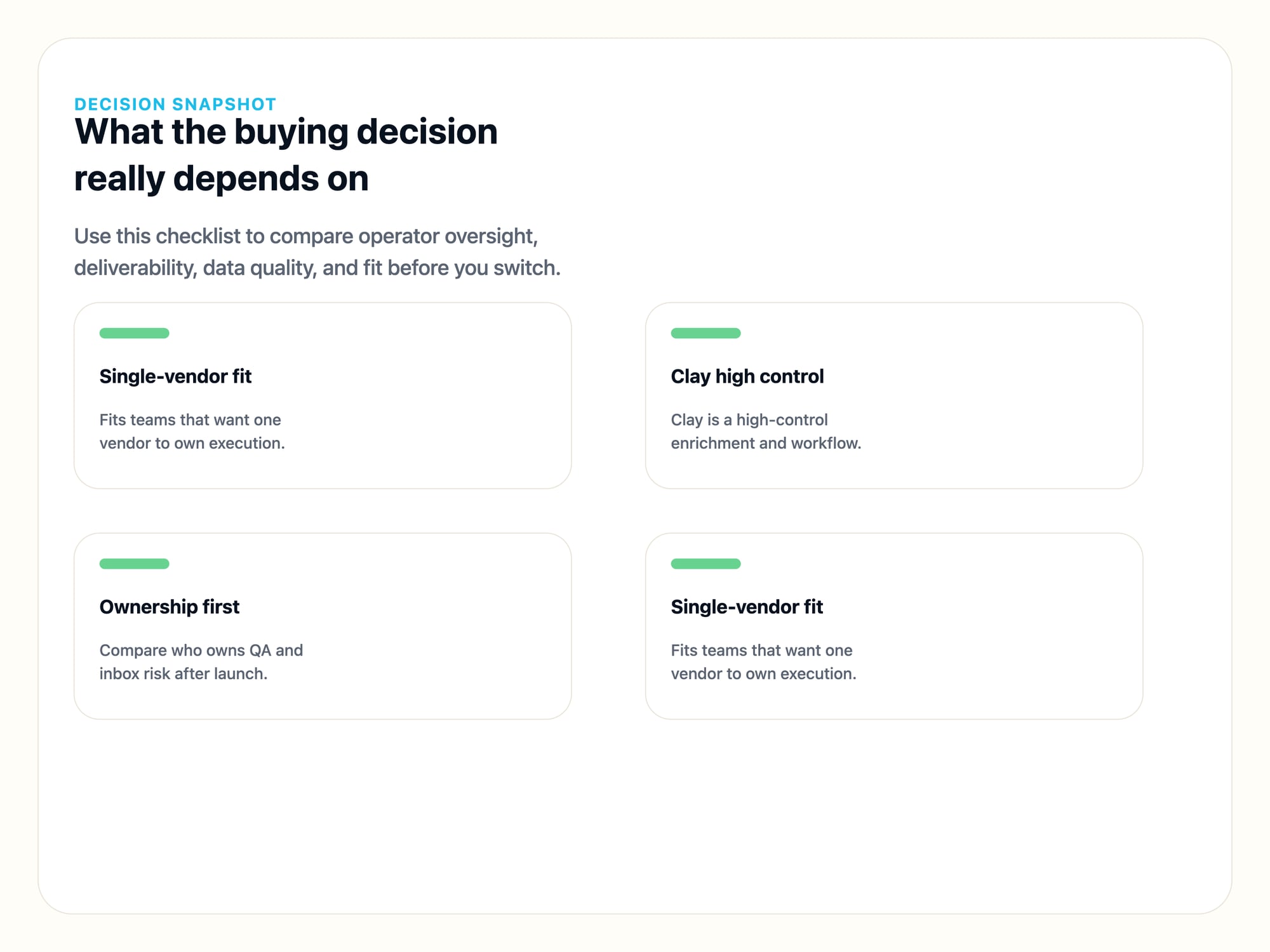
TL;DR
- Clay, 11x, Artisan, and Convert are not the same kind of outbound solution, so a simple feature comparison usually misses the real tradeoff.
- Clay is a high-control enrichment and workflow stack. That gives you flexibility, but it also creates more assembly and internal QA work.
- 11x is closer to software-led autonomous outbound. That can be attractive, but someone still has to own the system once it is live.
- Artisan is an AI-first outbound platform with a more consolidated tooling story, but consolidation does not remove execution responsibility.
- Convert is managed AI outbound with operator oversight: deliverability-first AI outbound with human QA.
Why this comparison gets confusing
A lot of bad buying decisions start when teams treat all of these options like they are just different versions of AI SDR.
They are not.
They solve different problems and leave different burdens with your team after launch. That is the distinction that matters most.
If you get that part wrong, the product can look right in the demo and still be the wrong operating model in practice.
What each model is really asking your team to own
The cleanest way to compare these tools is to look at the burden they leave with you.
Clay
Clay is a high-control enrichment and workflow stack.
That is a strong fit if you want flexibility, richer data orchestration, and you already have operator talent in-house.
The tradeoff is more assembly, more workflow design, and more internal QA burden.
If your team wants to build and control the system directly, that can be the right trade.
11x
11x is a different bet.
It is software-led autonomous outbound with explicit automation and deliverability language around 24/7 prospecting, mailbox management, domain warming, inbox rotation, and send-limit optimization.
That can be attractive if you want more autonomous software execution.
But you still need to ask who owns the system when the automation starts making decisions your team is not really reviewing.
Artisan
Artisan is different again.
It is an AI-first outbound platform with a named AI BDR story, plus platform language around B2B data, enrichment, personalization waterfall, email outreach, and intent-triggered outbound.
That can be a better fit if you want more consolidated tooling.
But platform consolidation does not remove execution tradeoffs. Someone still has to own targeting, QA, deliverability, and meeting quality.
Convert
Convert is the different shape in this group.
It is not a build-it-yourself control layer like Clay. It is not software-led autonomy like 11x. And it is not just a consolidated AI platform story.
It is managed AI outbound with operator oversight.
That is the point of the wedge: deliverability-first AI outbound with human QA.
The real choice is not "which AI SDR is best"
Once you frame the market this way, the decision gets more useful.
The question is not really which AI SDR is best. It is which burden you want to own.
For most teams, the tradeoff looks like this:
- Clay: stack assembly and internal QA
- 11x: software oversight after autonomous launch
- Artisan: platform convenience with execution tradeoffs
- Convert: a managed model with stronger operator ownership
That is a better buying lens because it reflects what your team will still be responsible for after the system is live.
A simple comparison grid
At this point, most readers want to see the tradeoffs side by side. A simple grid makes that easier.
| Model | Primary burden you own | Best fit | | — | — | — | | Clay | stack assembly and internal QA | teams that want maximum control and already have strong operators | | 11x | software oversight after autonomous launch | teams that want more software-led autonomy and can truly manage it | | Artisan | platform convenience with execution tradeoffs | teams that want consolidated tooling and accept the operating tradeoffs | | Convert | managed execution with operator oversight | teams that want AI leverage without giving up too much control over deliverability, QA, and meeting quality |
Where Convert is different in practice
Convert is built for teams that want AI leverage without giving up too much ownership over deliverability, QA, and meeting quality.
Public Convert materials make that operating model fairly legible:
- 100+ warmed inboxes
- 99% deliverability positioning via inbox rotation and infrastructure discipline
- a playbook built around at least 10 domains and about 100 inboxes total
- a 14-day warm-up ramp from 5 to 50 sends per day
- SPF, DKIM, DMARC, placement tests, and blacklist monitoring
- AI recommendations reviewed by humans before deployment
- QA tied to sent-to-reply, reply-to-positive, and positive-to-meeting
That is a different model from buying software and hoping your team owns the motion tightly enough later.
It is also different from assuming a more consolidated platform will solve the execution problem by itself.
Who each option is a better fit for
This is where the answer gets practical.
Clay may be the better answer if you want maximum internal control and already have strong operator talent.
11x may fit better if you want software autonomy and your team can genuinely own the system once it is running.
Artisan may make more sense if you want a more consolidated platform and are comfortable with the execution tradeoffs that still come with it.
Convert is more interesting if you want a managed model with stronger operator ownership, especially if you care about deliverability discipline, QA visibility, and meeting quality.
That is also why Convert is not for everyone.
What to ask before you choose
Before you buy anything in this category, ask a few blunt questions:
- who owns targeting after launch?
- who owns deliverability?
- who owns QA?
- who owns meeting quality?
- who can clearly explain why the motion is working when results change?
Those answers matter more than almost any product demo.
If ownership is fuzzy, the system is weaker than it looks.
FAQ
Is Clay the same type of product as 11x or Artisan?
No. Clay is better understood as a high-control enrichment and workflow stack, while 11x and Artisan are closer to software-led or platform-led outbound models.
Is Convert just another AI SDR platform?
Not really. Convert is positioned as managed AI outbound with operator oversight, with a deliverability-first AI outbound with human QA model.
What is the main thing founders should evaluate here?
Evaluate ownership. The key question is not which tool sounds smartest. It is which team will still own execution quality after launch.
If you want help thinking through which model fits your team, book time with Convert.
Want the operator view?
If you want the exact setup we’d use for your outbound, book time with us. We’ll show you what to fix first, what to automate, and where human QA still matters.