
Operator comparison guide
Most outbound teams count meetings too early and too loosely. A booked slot is not the same thing as a quality meeting.
A quality meeting is a conversation with the right buyer, around the right pain, with enough relevance and trust to create a real next step. That is the standard that matters in managed AI outbound.
TL;DR
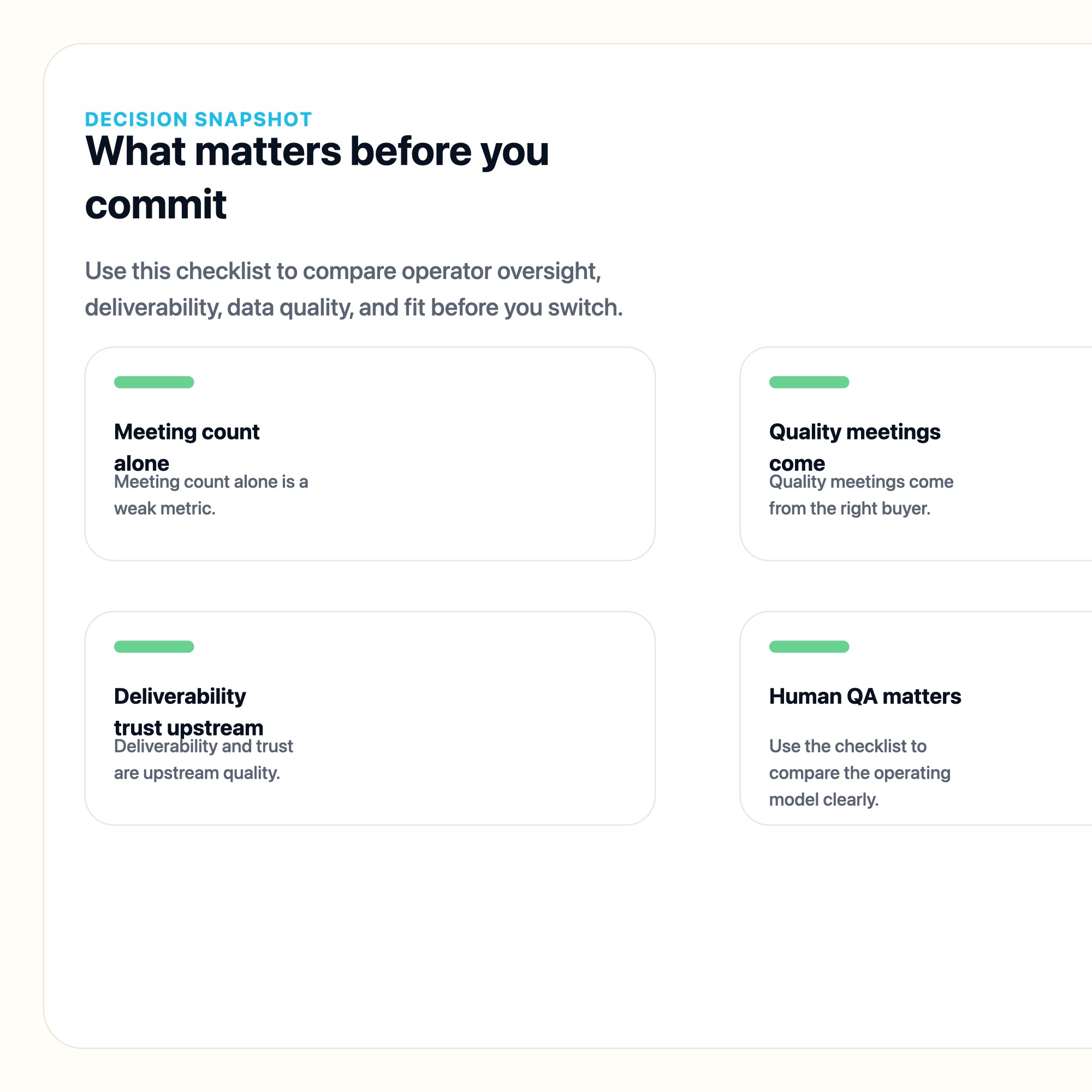
- Meeting count alone is a weak metric because a booked calendar slot can still be low quality.
- Quality meetings come from the right buyer, the right reason to talk, and enough trust to move the conversation forward.
- Deliverability and trust are upstream quality controls, not separate technical concerns.
- Human QA matters because weak targeting, weak claims, and weak-fit accounts can poison the pipeline before anyone notices.
- The best way to judge managed AI outbound is through ratios and pipeline usefulness, not meeting volume alone.
A booked meeting is not the same as a quality meeting
This is where a lot of outbound reporting gets blurry.
Teams celebrate booked meetings before asking whether those meetings were actually useful. That is how you get a calendar that looks busy and a pipeline that still feels thin.
A quality meeting should do a few things at once:
- map to the real ICP
- involve a buyer with real relevance to the problem
- have a credible reason for the conversation now
- create a real next step, not just a polite call
That sounds obvious, but it gets missed all the time. When teams optimize too hard for volume, they start counting any positive reply or booked slot as progress.
That is usually where quality starts slipping.
The right buyer matters before the copy matters
Most weak meetings start with weak segmentation, not weak copy.
If the account is wrong, the title is wrong, or the person is not close enough to the problem, the meeting will feel thin even if the email gets a reply.
That is why segmentation quality matters before copy quality does. The first job is not to write something clever. It is to make sure the motion is pointed at the right buyer.
This is also why founder-led teams should be careful with broad targeting. If the ICP is loose, the meeting standard gets loose with it.
A strong outbound system protects against that early. It does not wait until after the calendar fills up to discover that the wrong people are showing up.
The right reason for the meeting matters too
A quality meeting is not just with the right person. It is with the right person for the right reason.
That means there has to be a real why now, not just mild curiosity or a generic willingness to take a call.
This is where better research and better proof matter. Public Convert materials are useful here because they describe research dossiers built from signals like news, podcasts, reports, and broader enrichment inputs. That matters because it points to a system built around relevance, not fake personalization.
The same rule applies to proof. The best proof is usually not the biggest logo. It is the proof that feels closest to the buyer's world.
When that part is weak, the meeting may still get booked. It just usually will not go anywhere useful.
Deliverability and trust are upstream quality controls
A lot of teams treat deliverability as a separate technical concern.
It is not. Deliverability and trust sit upstream of meeting quality.
When infrastructure is weak, reply quality usually gets noisier. Trust drops. Signal quality gets worse. And once that starts happening, the meetings usually get weaker too.
That is one reason Convert's public operating model is useful as evidence. Public materials describe 100+ warmed inboxes, a supplementary-domain setup built around roughly 10 domains and 100 inboxes, a 14-day warm-up ramp from 5 to 50 sends per day, plus SPF, DKIM, DMARC, inbox placement tests, blacklist monitoring, and rotation discipline.
That matters because it shows quality protection starting before the meeting is ever booked.
A simple process visual fits well here. It should show the path from infrastructure setup, to launch, to reply quality, to positive replies, to quality meetings. That makes the upstream logic easier to scan.
Human QA is what stops weak meetings from multiplying
A lot of weak meetings come from judgment problems, not software problems.
That usually means:
- bad-fit accounts slipping through
- claims that are technically true but not convincing
- weak buying context
- follow-up logic that pushes too hard
- campaigns staying live after quality is already drifting
This is where human QA matters.
The useful question is not whether humans are involved in the process. The useful question is what their review prevents.
Based on Convert's public operating model, human review matters before deployment and during post-launch QA. That matters because it changes who is responsible for catching weak targeting, weak proof, and weak-fit meetings before they spread through the pipeline.
That is also where managed AI outbound separates from generic AI SDR automation. If nobody owns quality control, booked activity can rise while real meeting quality falls.
The metrics that actually tell you if meetings are good
Meeting count is a weak headline metric on its own.
The better way to judge managed AI outbound is through ratio-based quality signals and downstream usefulness.
The most useful ones are:
- sent-to-reply ratio
- reply-to-positive ratio
- positive-to-meeting ratio
- meeting-to-pipeline usefulness
These metrics tell you different things.
If sent-to-reply is healthy but reply-to-positive falls, the issue may be targeting, proof, or offer quality. If positive-to-meeting falls, the issue may be qualification or real buyer intent. If meetings are getting booked but very little turns into next steps or pipeline value, the team is probably counting meetings too generously.
Convert's public materials help here too because they explicitly reference QA tied to sent-to-reply, reply-to-positive, and positive-to-meeting ratios. That matters because it shows a real quality-control loop, not just campaign launch.
When managed AI outbound is a bad fit
This model is not right for every team.
It is probably a bad fit if:
- you mainly want a fully self-serve software workflow
- you do not have a clear offer or credible proof yet
- you are trying to scale volume before fixing targeting and quality control
- you are willing to trade meeting quality for more booked activity
That fit boundary matters. A model built around deliverability, QA, and operator oversight is most useful for teams that care about qualified meetings, sender protection, and real downstream pipeline value.
What to look for in a quality-meeting motion
If you are judging managed AI outbound, do not stop at meeting count.
Ask whether the meetings are coming from the right buyers, for the right reasons, through infrastructure that protects trust, with human review catching weak-fit activity before it compounds.
That is what quality looks like.
If you want a practical outside-in read on whether your outbound motion is producing real meetings or just calendar activity, book time with Convert.
Want the operator view?
If you want the exact setup we’d use for your outbound, book time with us. We’ll show you what to fix first, what to automate, and where human QA still matters.